

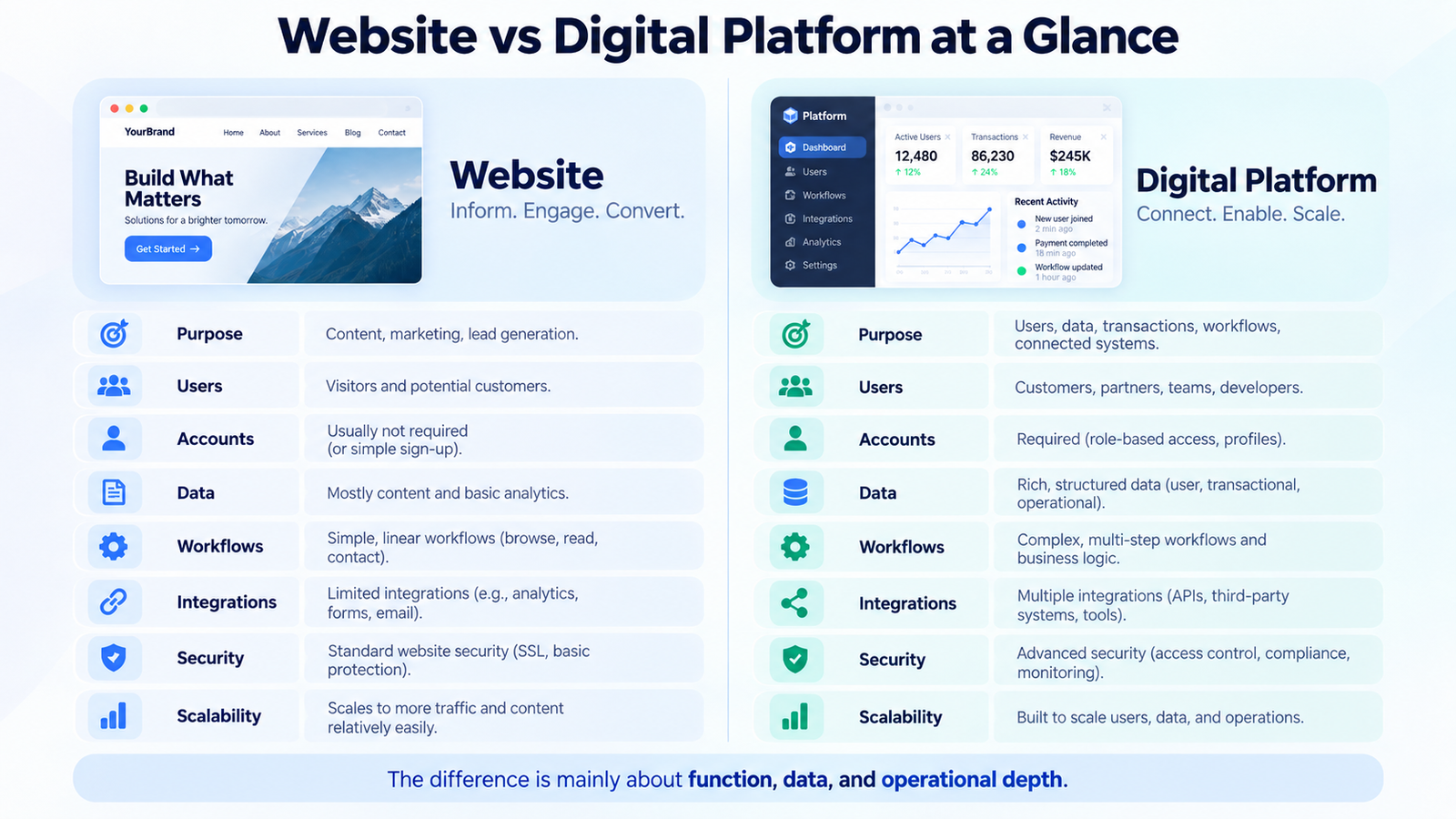
The difference between a website vs digital platform is less about what appears on the screen and more about what the system is responsible for doing.
A website usually focuses on presenting information, publishing content, marketing products or services, and helping visitors complete defined actions such as contacting a company, booking an appointment, subscribing, or purchasing something.
A website vs digital platform usually plays a deeper operational role. It may coordinate users, retain their data, manage workflows, process transactions, connect different participant groups, integrate with other systems, or continuously deliver a digital service.
However, there is no absolute boundary. A modern website can be highly interactive, and many digital platforms are accessed entirely through a website interface.
What Is a Website?
A website is a collection of web-accessible pages, resources and functionality forming an online presence.
Businesses commonly use websites for:
- Brand visibility
- Publishing information
- SEO
- Lead generation
- Content marketing
- Ecommerce
- Bookings
- Customer communication
- Product or service presentation
A website does not have to be static.
Modern websites may use databases, forms, dynamic content, personalization, search, payment systems, logins, ecommerce features and third-party integrations.
That means “interactive” does not automatically mean “platform.”
A restaurant could operate a website containing menus, reservations, customer reviews and online payments while still reasonably describing the product as a website.
What Is a Digital Platform?
“Website vs digital platform” has several meanings.
The OECD, for example, uses an online-platform definition focused on services connecting two or more distinct but interdependent groups of users. It also explicitly recognizes that there is no single universally accepted platform definition.
In everyday business technology, the term is also used more broadly for software environments through which customers, partners, employees or other users perform ongoing activities.
For this comparison, a useful working definition is:
A digital platform is a software environment that supports recurring interactions, workflows, transactions, data exchange or digital service delivery among users, organizations or connected systems.
Typical characteristics may include:
- Persistent accounts
- User roles
- Permissions
- Structured operational data
- Dashboards
- Transactions
- Workflow automation
- Personalization
- APIs
- Integrations
- Notifications
- Business rules
- Multiple participant groups
Not every platform requires all of these.
Website vs Digital Platform at a Glance
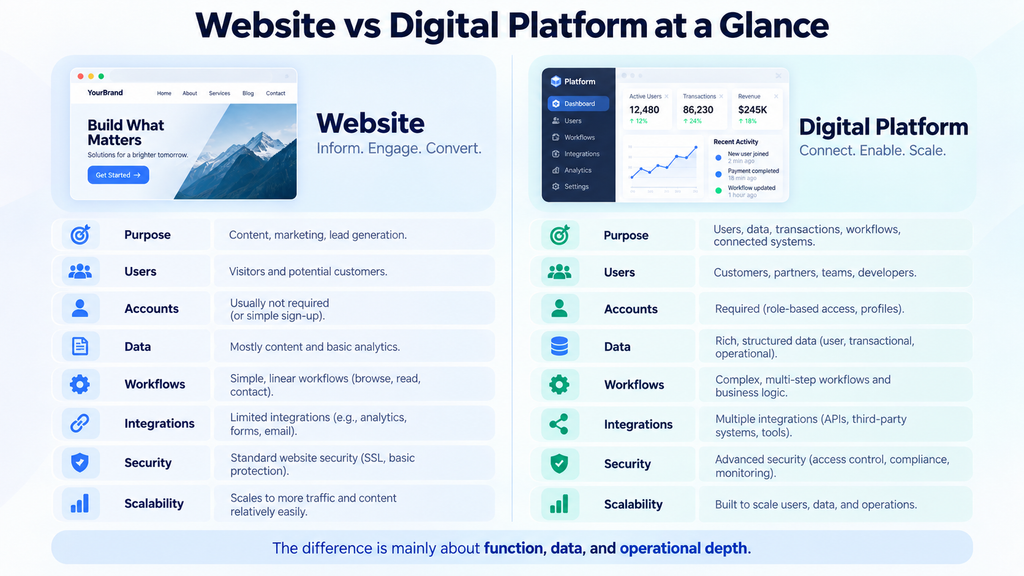
The main difference is business function.
A website often acts as a communication, marketing, content or sales channel.
A platform usually becomes part of how the underlying service or organization actually operates.
For example, compare two insurance products.
An insurance website might explain policies, publish educational material, display contact information and collect quote requests.
An insurance platform might allow customers to register, upload claim evidence, see claim status, communicate with staff, receive decisions, update records, make payments and maintain an auditable transaction history.
Both are delivered through the web, but their operational responsibilities are very different.
The Biggest Difference Is What the Product Is Designed to Do
Instead of asking how many pages a project has, ask what business function it performs.
Website-first goals often include:
- Visibility
- Credibility
- SEO
- Education
- Content
- Lead acquisition
- Product presentation
Platform-first goals commonly involve:
- Managing users
- Processing recurring transactions
- Automating workflows
- Managing documents
- Coordinating different parties
- Delivering personalized services
- Synchronizing business systems
- Maintaining operational records
A publication with 50,000 pages can fundamentally remain a website.
A claims application containing ten main screens can be a far more complex software product.
Websites Serve Visitors; Platforms Often Manage Participants
A typical public website may primarily deal with anonymous visitors, editors and administrators.
A platform may maintain several persistent participant roles, such as:
- Customer
- Seller
- Buyer
- Employee
- Partner
- Instructor
- Student
- Vendor
- Administrator
Multiple roles alone do not create a platform, but they are often a sign that the software is managing relationships rather than simply publishing information.
Data Is One of the Clearest Architectural Differences
Websites can absolutely use databases.
A marketing site may store:
- Contact submissions
- Newsletter subscriptions
- CMS content
- Orders
- Analytics data
A platform may depend operationally on data such as:
- User profiles
- Permissions
- Transaction histories
- Uploaded documents
- Workflow states
- Messages
- Orders
- Preferences
- Activity histories
The more valuable and persistent that data becomes, the more attention the system usually requires around privacy, authorization, retention, backups and recovery.
Platforms Often Manage Ongoing Workflows
Consider a document-submission process.
A website flow might be:
Visitor completes form → business receives request.
A platform workflow might be:
Customer creates account → uploads documents → staff reviews submission → status changes → customer receives notification → payment is processed → records and audit history are retained.
The second system is not simply “more interactive.” It is coordinating a continuing business process.
Is an Ecommerce Website a Digital Platform?
Sometimes—but not automatically.
A business selling its own products through a storefront can reasonably describe its product as an ecommerce website.
A marketplace becomes much more platform-like when it coordinates:
- Multiple sellers
- Buyers
- Listings
- Payments
- Reviews
- Seller accounts
- Fulfillment
- Disputes
This distinction is particularly important with Shopify.
Shopify describes itself as a commerce platform, while also giving merchants tools for creating online stores and ecommerce websites. A merchant website running on Shopify therefore does not automatically become a platform in the marketplace/business-system sense merely because its underlying software provider is a platform.
Website vs Web App vs Digital Platform
These terms overlap but are not interchangeable.
Website
Usually organized around content, information, navigation and defined visitor actions.
Web application
Browser-accessed software allowing users to perform tasks, manipulate information or complete workflows.
Web application frameworks commonly provide database integration, sessions, routing, authorization and security functionality.
Digital platform
A broader system coordinating interactions, participants, services, data or connected applications.
A web application may therefore be the main interface of a platform without every web application being a platform.
A mortgage calculator, for example, can be a web application while remaining a relatively self-contained tool.
Is a Customer Portal a Digital Platform?
It depends.
A secure page where a customer downloads invoices could simply be a portal or application feature.
A customer environment integrating:
- Accounts
- Documents
- Payments
- Workflow status
- Support
- CRM records
- ERP data
- Different permissions
may serve as a major component of a digital service platform.
The label matters less than defining the actual functionality.
Is a Marketplace a Digital Platform?
Marketplaces are among the clearest platform examples.
OECD’s platform definition specifically emphasizes interaction between distinct but interdependent groups.
For example:
Airbnb: hosts ↔ guests
Ride-sharing platform: drivers ↔ riders
Product marketplace: sellers ↔ buyers
The system creates value partly by facilitating interactions between these groups.
In some platform businesses, network effects also become important: additional participants on one or both sides can increase the service’s value to others. HBS describes both same-side and cross-side network effects in this context.
But not every website vs digital platform needs network effects. An internal employee platform might have no marketplace economics at all.
Is a CMS a Digital Platform?
Context matters.
WordPress can reasonably be called a publishing or technology platform because it provides an extensible foundation for building websites. WordPress itself describes the software as a publishing platform used across many sites.
But a five-page company website built with WordPress is not automatically a digital business platform.
The software used to build a site and the resulting business product are different things.
Is SaaS the Same as a Digital Platform?
No.
Software as a Service (SaaS) primarily describes how software is provided to customers.
NIST defines SaaS around users accessing a provider’s applications running on cloud infrastructure while the provider manages the underlying infrastructure.
A SaaS product might be:
- A standalone application
- A specialized business tool
- A digital platform
A SaaS product becomes more platform-like when it develops a broader environment around APIs, extensions, partners, user groups, integrations or reusable services.
Platform Business Model vs Platform Technology
This distinction prevents a lot of confusion.
A platform business model creates value by facilitating interaction between participant groups.
HBS describes platform businesses around this user-group interaction model.
A technology platform provides reusable software capabilities, APIs, infrastructure or tools.
An organization can therefore have:
- Platform technology without marketplace economics.
- A marketplace business built with platform technology.
- An internal platform serving employees.
- A developer platform used to build other applications.
How Website and Platform Architecture Differ
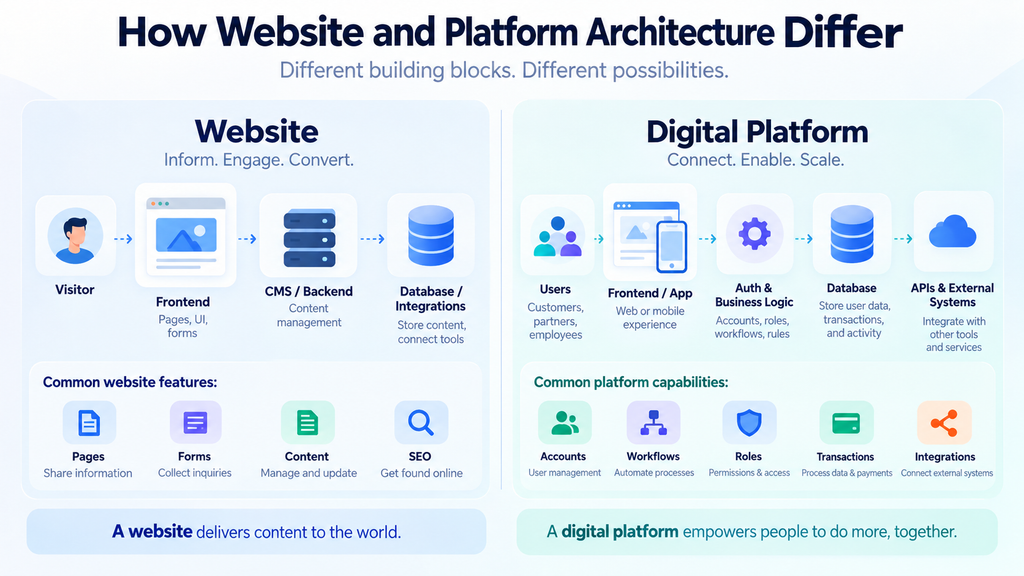
A conventional business website might use:
Visitor → Frontend → CMS/database → integrations
A digital platform might involve:
Users → frontend/application → authentication → business logic → databases → APIs → external systems
Depending on its requirements, it may additionally use:
- Role-based authorization
- Notifications
- Search services
- Payment services
- Background processing
- Audit logging
- Integration layers
- Monitoring systems
But none of this means platforms require microservices, Kubernetes or an elaborate distributed architecture.
AWS itself notes that architecture decisions should reflect scale, complexity and the use case, and acknowledges circumstances where monolithic or alternative approaches remain appropriate.
A well-designed modular monolith can therefore be a perfectly reasonable starting architecture for many products.
Why Digital Platforms Usually Need More Security Planning
Every public website needs security.
Platforms, however, often increase the attack surface because they may handle:
- Accounts
- Authentication
- Personal data
- Documents
- Payments
- Permissions
- Private records
- Operational processes
Depending on risk, appropriate controls may include authentication, MFA, authorization, encryption, secure file handling, rate limiting, audit logging, vulnerability management and reliable backups.
The appropriate controls depend on the application’s actual risk profile.
Platforms Often Create More Privacy and Compliance Requirements
Requirements depend heavily on country, industry, user population and data type.
Relevant considerations may include:
- Privacy notices
- Consent
- Retention policies
- Data-access rights
- Payment security
- Accessibility
- Audit requirements
- Sector-specific regulation
These requirements should be defined during planning rather than treated as a late-stage feature.
Why Digital Platforms Usually Cost More to Build
Giving universal website-versus-platform price ranges is misleading.
Cost depends on scope.
Platform costs often increase because teams must design and test things such as:
- Accounts
- Permissions
- Data models
- Workflows
- Admin tools
- Dashboards
- Integrations
- Payments
- Search
- Security
- Monitoring
- Infrastructure
The launch budget is also only part of the picture.
A platform may continue to require infrastructure management, backups, support, integration maintenance, security updates, feature development and product management.
Website Maintenance vs Platform Operations
Website maintenance commonly includes:
- Content updates
- CMS updates
- SEO
- Performance
- Hosting
- Security
Platform operations may include these plus:
- User support
- Application monitoring
- Data integrity
- API changes
- Background jobs
- Payment failures
- Permissions
- Incident management
Scale matters. A small platform does not automatically require a large operations team.
Scalability Means More Than Handling More Visitors
For a content website, scalability may mainly mean:
- More visitors
- More pages
- More content requests
For a platform, growth may simultaneously create:
- More users
- More transactions
- More records
- More uploaded files
- More API calls
- More background jobs
- More workflows
- More participant types
That broader definition of scale can strongly influence architecture.
How SEO Differs for Websites and Digital Platforms
A public website normally places significant emphasis on crawlable landing pages, content, internal linking, metadata, structured data and information architecture.
A platform often contains private areas that search engines should not index.
However, digital platforms can still depend heavily on SEO through public:
- Category pages
- Marketplace listings
- Documentation
- Help resources
- Product pages
- Educational content
SEO therefore does not disappear when a company builds a platform.
Public acquisition content and private application functionality simply have different requirements.
Website UX vs Platform UX
Website UX frequently focuses on:
- Navigation
- Information discovery
- Reading
- Conversion
- Calls to action
Platform UX usually needs additional attention to:
- Task completion
- Status
- Data entry
- Dashboards
- Errors
- Empty states
- Permissions
- Notifications
- Repeated use
Users may return daily or weekly and expect the system to remember where they are in a process.
Website Analytics vs Product Analytics
Website analytics commonly tracks:
- Traffic
- Acquisition
- Search performance
- Leads
- Conversion
Platform teams may additionally monitor:
- Activation
- Retention
- Feature adoption
- Workflow completion
- Transaction success
- Drop-off
- User cohorts
These categories overlap; they are not mutually exclusive.
When Does a Website Become a Digital Platform?
There is no universal technical threshold.
Instead, look for cumulative signals:
- Persistent user accounts
- User-specific records
- Multiple permissions
- Recurring workflows
- Complex transactions
- Multiple participant groups
- Personalization
- Deep integrations
- Automation
- API ecosystems
- Daily operational dependence
The transition is usually gradual.
A Simple Platform-Maturity Continuum
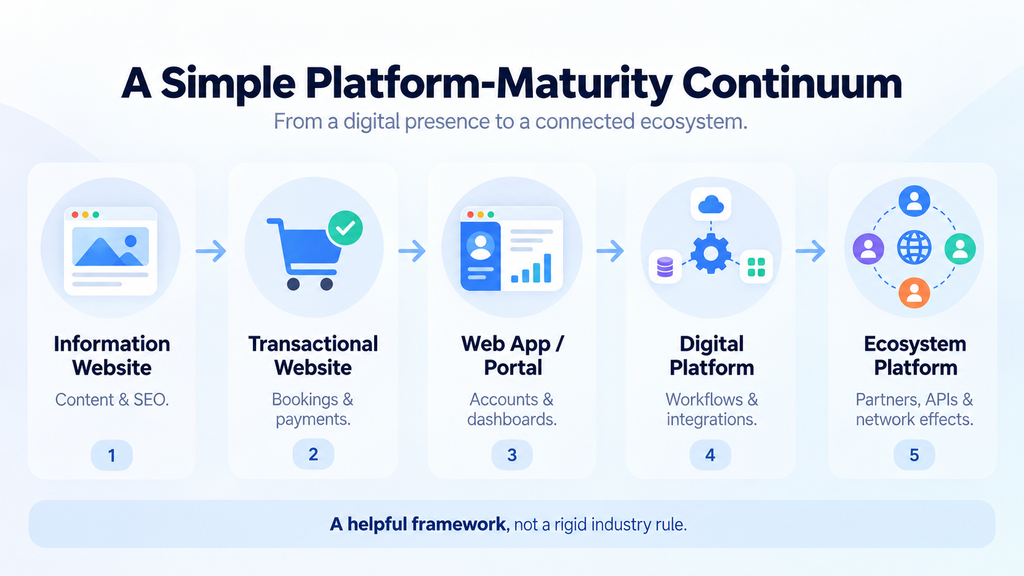
One useful way to think about the progression is:
Information website → transactional website → web application/portal → digital platform → ecosystem platform
This is an explanatory framework rather than an official industry classification.
It is useful because many businesses move through these stages gradually instead of jumping directly from a basic site into a large custom platform.
When a Website Is Enough
A website may be entirely appropriate when:
- Credibility is the main goal.
- Services need explaining.
- SEO/content is important.
- Leads are the primary conversion.
- Transactions are straightforward.
- Operational work occurs in other systems.
- Persistent user accounts are unnecessary.
- Workflows are limited.
Choosing a website is not a lesser technical decision.
It is often the most efficient architecture for the requirement.
When You May Need a Digital Platform
Platform requirements become worth exploring when:
- Customers manage persistent accounts or data.
- Different groups need different permissions.
- Users upload and update records.
- Transactions happen repeatedly.
- Several parties interact.
- Workflows contain many stages.
- Employees need operational dashboards.
- Multiple systems must remain synchronized.
- Manual handoffs are creating bottlenecks.
- Automation is central to service delivery.
Can You Start With a Website and Build a Platform Later?
Yes—when the likely next stage is considered realistically.
Useful foundations may include:
- Sensible data structure
- Clear separation of public content and private application areas
- Appropriate authentication planning
- Maintainable integrations
- Modular application design
- APIs where they solve a real requirement
But building for every hypothetical future possibility creates another problem: overengineering.
The better target is credible next-stage growth, not imaginary scale.
Should You Build the Full Platform Immediately?
Often, you do not need to.
A hypothetical roadmap could be:
Phase 1: Public website and lead generation
Phase 2: Customer accounts
Phase 3: Self-service workflows
Phase 4: Payments and system integrations
Phase 5: Partner or API ecosystem
That order is not universal.
Product development should follow validated business needs.
Website or Digital Platform: Which Do You Need?

Before hiring a developer, define the actual behavior of the product.
Ask:
- Who are the users?
- Do they require accounts?
- What information must remain between sessions?
- Do different users require different permissions?
- What workflows must they complete?
- Are transactions central?
- Do multiple participant groups interact?
- Which external systems must connect?
- What happens when an action fails?
- What information needs audit history?
- What needs to be public and indexed?
- What needs to remain private?
- How frequently will people use the system?
- Which processes are currently manual?
- What functionality is actually required for the first release?
If most requirements involve public information, content and straightforward conversions, a website may solve the problem.
If the product must continuously manage users, data, services, transactions and workflows, you are moving toward web-application or digital-platform territory.
The most important decision is therefore not whether a “website” or “platform” sounds more advanced.
It is defining what the technology must accomplish.
FAQs:
What is the difference between a Website vs digital platform?
A website usually emphasizes content, information, marketing or defined transactions. A digital platform generally coordinates deeper recurring activity involving users, data, workflows, transactions or connected systems.
Is a website a digital platform?
Not necessarily. Some websites contain platform functionality, and many platforms are accessed through websites. Classification depends more on function and architecture than on the interface.
What makes a website a platform?
There is no single threshold. Persistent accounts, operational data, multiple roles, recurring workflows, transactions, automation and system integrations together can make a product increasingly platform-like.
Is an ecommerce website a digital platform?
Sometimes. A single-brand store may simply be an ecommerce website. A marketplace connecting multiple sellers and buyers is more clearly a platform.
Is Shopify a website or platform?
Shopify itself is a commerce platform. A merchant can use Shopify to create an ecommerce website/store. The two levels should not be confused.
Is WordPress a website or platform?
WordPress is software/a publishing platform used to build websites. A particular WordPress installation may simply function as a website.
Is a web app a digital platform?
It can be, but not every web application qualifies as a platform. A standalone browser-based tool may simply be an application.
What are examples of digital platforms?
Common examples include marketplaces connecting sellers and buyers, ride-sharing environments connecting drivers and riders, learning platforms, customer-service environments and developer platforms. The precise classification depends on which definition of platform is being used.
Is SaaS the same as a digital platform?
No. SaaS describes a way software is delivered. A SaaS product may or may not also function as a platform.
Can a website become a digital platform?
Yes. Businesses can progressively add accounts, application functionality, workflows, integrations and platform services as requirements develop.
