
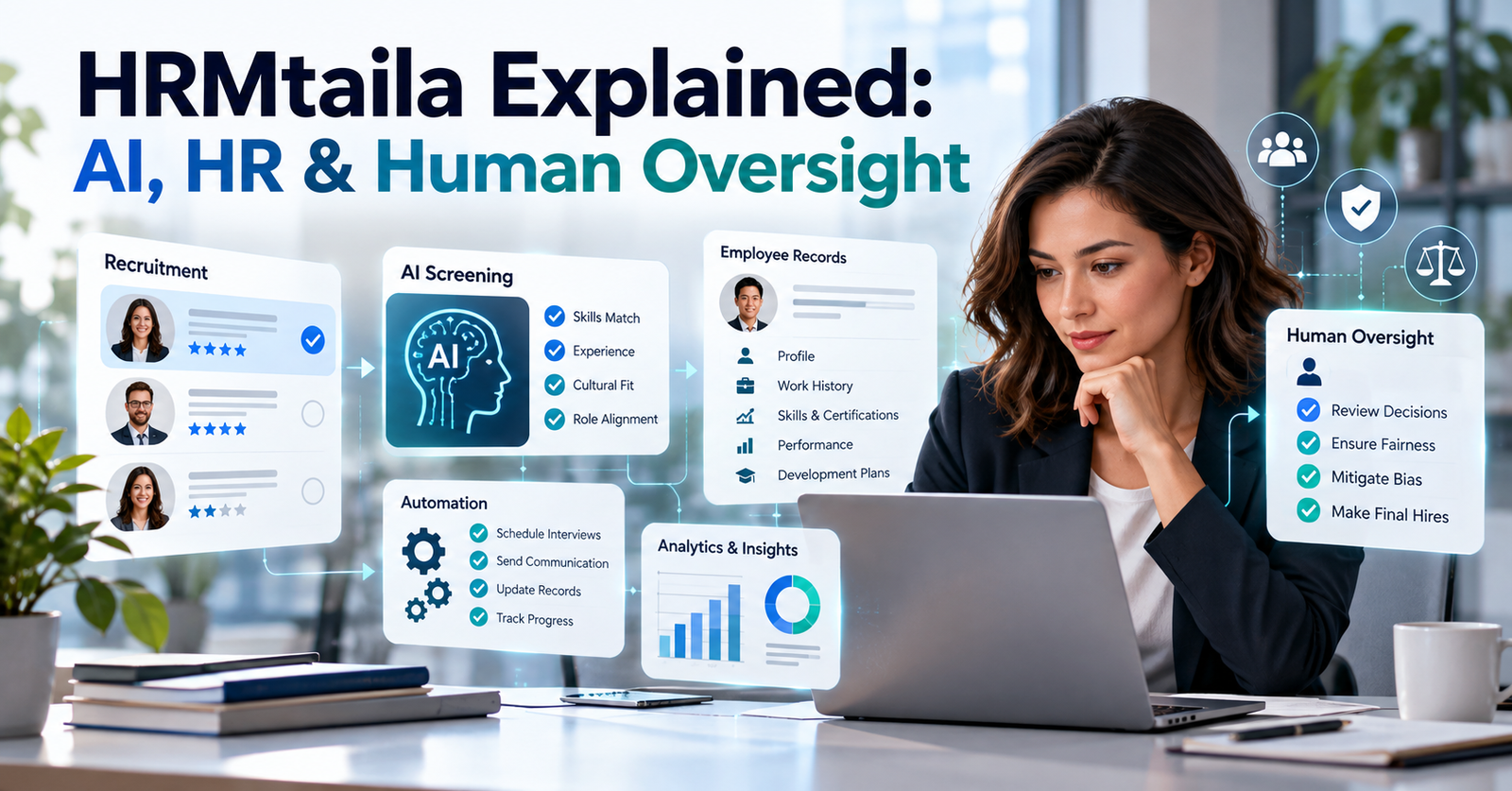
HRMtaila is an emerging online term associated with artificial intelligence, human resource management, HR automation, recruitment, employee support, and workforce analytics. However, the important distinction is that current public evidence does not establish HRMtaila as a recognized HR standard, established software company, or verified commercial platform.
The search footprint around the term is recent and consists largely of explanatory articles connecting HRMtaila with broader developments in AI-powered human resources. That makes it useful to separate two questions: What is actually known about HRMtaila? And what can real AI-powered HR technology actually do?
This article does both while avoiding unsupported claims about products, pricing, founders, apps, or features, as required by the research brief.
What Is HRMtaila?
HRMtaila is an emerging online term that recent articles associate with AI-assisted human resource management, including recruitment automation, employee support, workforce analytics, and digital HR processes. There is currently no authoritative universal definition or sufficient primary evidence establishing HRMtaila as a specific commercial software product, company, or recognized HR technology standard.
The underlying subject—AI in human resources—is well established. What remains uncertain is whether HRMtaila represents anything more specific than a recently emerging label used in online discussions.
HRMtaila at a Glance
| Question | Current evidence |
| What is HRMtaila? | Emerging term associated with AI and HR |
| Official definition? | Not verified |
| Verified company? | Not verified |
| Verified founder? | Not verified |
| Official website? | Not verified |
| Commercial software? | Not established |
| Pricing? | No verified pricing found |
| Mobile app? | No verified app established |
| Recognized HR standard? | No evidence found |
| Main online association? | AI-assisted human resource management |
| Earliest accessible usage found in this research? | September 2, 2026 |
| Research date | September 28, 2026 |
An accessible article published September 2, 2026 described HRMtaila as an unclear emerging search term rather than a known technology brand. Searches also surfaced articles from September 11, 14, 15, 17 and later in the month. That establishes a visible September 2026 footprint, but it does not prove the term was invented that month or identify its original creator.
Is HRMtaila a Real HR Software Platform?
There is currently insufficient evidence to describe HRMtaila as an established commercial HR software product.
A conventional software vendor normally leaves a verifiable trail: an identifiable company, official product documentation, privacy and security information, support channels, demonstrations, pricing, integrations, customers, developer documentation, or independent software reviews.
Current HRMtaila search results instead consist primarily of explanatory articles. Some explicitly acknowledge that no confirmed software company, developer, founder, customer list, pricing structure, mobile application, or integrations have been established.
Multiple articles repeating similar product-like concepts are not, by themselves, evidence that a product exists.
Is There an Official HRMtaila Website?
No authoritative official HRMtaila product website was verified during this research.
A web page containing “HRMtaila” in its title or URL should not automatically be treated as an official website. Establishing an official product site would require stronger evidence linking the domain to an identifiable company, developer, organization, or documented service.
For now, readers should distinguish between articles about HRMtaila and an official HRMtaila organization or product site.
Where Did the HRMtaila Term Come From?
The origin remains unresolved.
The earliest accessible dated result found during this research was published on September 2, 2026. Other visible articles appeared during the following weeks. This suggests that the currently searchable footprint is recent.
However, that finding does not establish:
- who coined the term;
- whether an earlier unindexed use exists;
- whether it originated with a company;
- whether it began as a search term, project name, or something else.
No reliable creator or original definition was identified. It would therefore be inaccurate to say that HRMtaila was “invented in 2026” without stronger primary evidence.
What Does HRMtaila Stand For?
The letters HRM commonly stand for Human Resource Management, which fits the context in which HRMtaila is currently discussed.
The remainder of the word has no independently verified expansion.
There is no identified original creator who has published an authoritative acronym explaining “taila.” Claims that expand every letter into terms such as technology, artificial intelligence, learning, or automation should therefore be treated as speculation unless primary documentation appears.
Why Is HRMtaila Associated With AI?
Recent HRMtaila articles repeatedly connect the term with:
- artificial intelligence;
- recruitment;
- onboarding;
- HR automation;
- employee self-service;
- workforce analytics;
- performance management;
- payroll-related processes;
- digital employee information.
These are best described as themes associated with the keyword, not verified HRMtaila product features. Recent competitor content itself acknowledges this distinction.
HRMtaila vs. Established AI HR Software
| Evidence area | HRMtaila | Established AI HR software |
| Identifiable company | Not verified | Normally identifiable |
| Product documentation | Not verified | Typically available |
| Pricing | Not verified | May be public or quote-based |
| Customers | Not verified | Often documented |
| Integrations | Not verified | Usually documented |
| Customer support | Not verified | Expected |
| Privacy information | No verified official product policy | Normally published |
| Security documentation | Not verified | Often available to buyers |
| Feature verification | Mostly article-level claims | Product documentation available |
| Independent reviews | No established product-review footprint verified | Often available |
This does not mean that a future product named HRMtaila cannot exist. It means the evidence presently available is insufficient for treating one as established.
How AI Is Actually Used in Human Resources
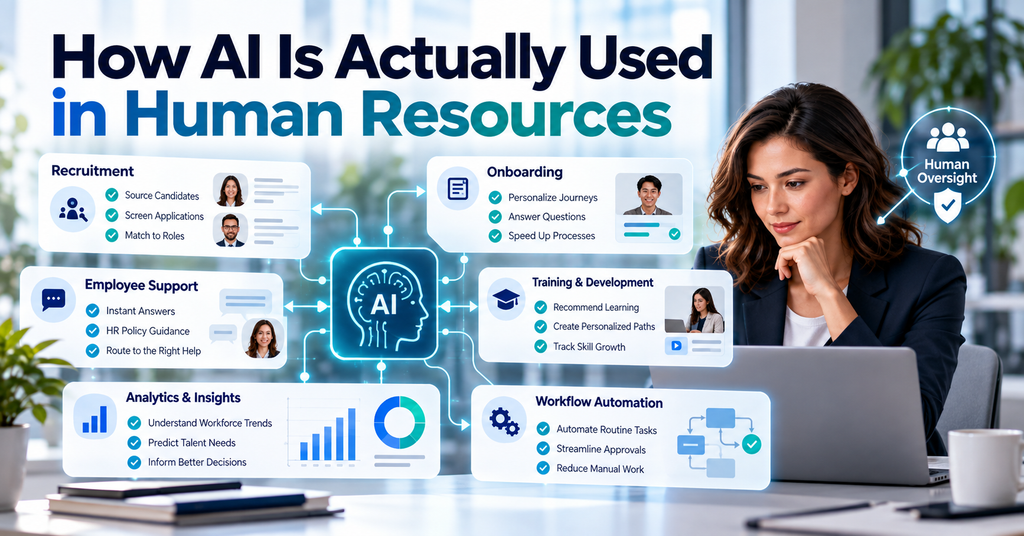
The broader AI-in-HR field is much easier to document.
Organizations can use AI or automation to assist with job-description drafting, candidate search, résumé organization, interview scheduling, onboarding workflows, employee knowledge assistants, training content, skills analysis, reporting, and workforce planning.
SHRM’s State of AI in HR 2026, published March 31, 2026, drew on responses from 1,908 HR professionals and examined how AI is being adopted across HR functions.
AI in Recruitment
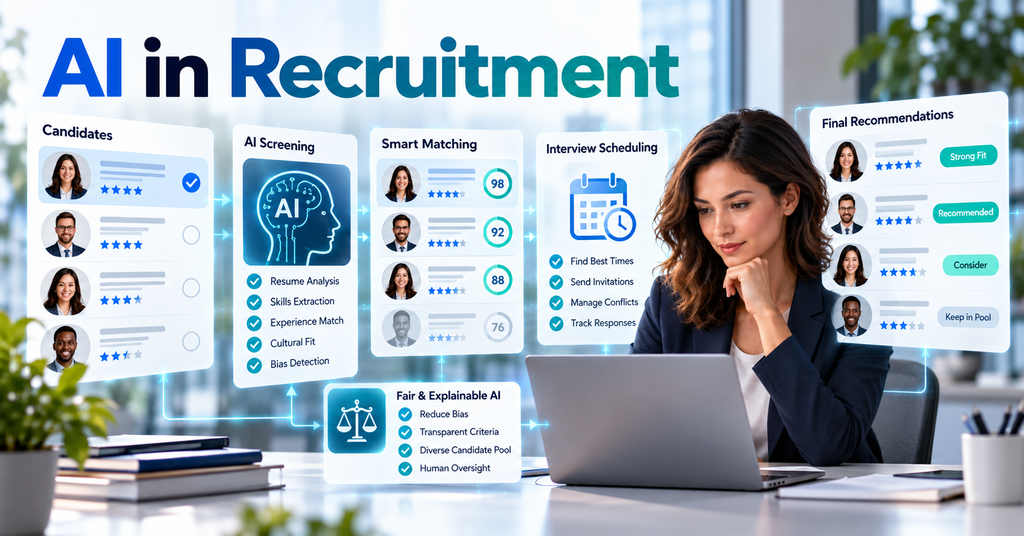
Recruitment is currently one of the strongest HR use cases for AI.
SHRM reported that 27% of organizations were using AI in recruiting, making it the largest HR functional area in its 2026 research. Common applications include writing job postings, résumé screening and matching, and interview scheduling.
Those efficiencies do not make automated recommendations automatically reliable or fair. Candidate screening systems can influence people’s employment opportunities, making validation, bias assessment, legal review, appropriate transparency, and meaningful human oversight important.
AI in Employee Onboarding
Automation can simplify repetitive onboarding steps such as:
- document reminders;
- completion checklists;
- training navigation;
- common FAQs;
- account-setup coordination;
- routing employees toward policies and resources.
AI can support these processes without being responsible for sensitive employment judgments.
Employees should also have a clear path to a human HR professional when a question involves personal circumstances, disputes, benefits issues, accommodations, or other matters requiring judgment.
AI Employee Self-Service and HR Assistants
Employee-facing AI assistants can make internal information easier to find.
They may answer routine questions about leave policies, benefits, procedures, training, or HR forms. The major risk is that a conversational system can provide outdated, incomplete, or incorrect answers.
An HR assistant therefore needs controlled information sources, privacy safeguards, testing, monitoring, and escalation routes rather than unrestricted authority.
AI and Workforce Analytics
Workforce analytics can help organizations study:
- turnover patterns;
- recruitment trends;
- skill gaps;
- attendance;
- staffing requirements;
- workforce planning.
AI can make large datasets easier to organize and analyze, but predictive outputs should not be confused with facts.
A statistical pattern suggesting that an employee might leave, for example, does not explain the employee’s circumstances and should not become an automatic basis for promotion, discipline, or termination.
AI in Performance Management
AI systems may help organize documented goals, summarize performance information, identify trends, or highlight potential development needs.
The limitations are significant. Work quality and employee contribution may depend on difficult assignments, collaboration, changing responsibilities, unavailable resources, workplace conditions, and other context that an automated metric may not capture.
Decisions involving compensation, promotion, warnings, or termination should therefore not be blindly delegated to an automated score.
Can AI Automate Payroll?
Automation can assist payroll systems with time and attendance data, calculations, information transfer, reporting, and anomaly detection.
That is different from saying generative AI should independently determine payroll compliance.
Wage rules, tax requirements, employee classifications, deductions, and exceptions can carry legal and financial consequences. Organizations still need appropriate controls and qualified review.
How Common Is AI in HR in 2026?
SHRM’s 2026 research offers a useful snapshot rather than evidence that every workplace uses AI.
| Metric | 2026 figure | Source | Population / limitation |
| Organizations implementing AI in HR | 39% | SHRM State of AI in HR 2026 | Research based on 1,908 HR professionals |
| Planning HR AI implementation in 2026 | 7% | SHRM | Same research program |
| No current AI implementation plans | 31% | SHRM | Organizational responses represented by surveyed HR professionals |
| AI use in recruiting | 27% | SHRM | HR functional adoption |
| AI use in HR technology | 21% | SHRM | HR functional adoption |
| AI use in learning & development | 17% | SHRM | HR functional adoption |
| HR functions not formally measuring AI investment success | 56% | SHRM | Measures formal evaluation of AI investment |
SHRM reports that 39% of organizations had implemented AI in HR, another 7% planned implementation during 2026, and 31% reported no plans. It also identified recruiting at 27%, HR technology at 21%, and learning and development at 17%.
The same research found that 56% of HR functions did not formally measure the success of their AI investments, while only 16% used ROI as a metric.
These figures should not be casually combined with older SHRM studies that used different methodologies or populations.
Benefits of AI in HR
When matched to an appropriate task, AI and automation may provide benefits such as:
- reducing repetitive administrative work;
- speeding up routine workflows;
- improving information retrieval;
- making processes more consistent;
- providing scalable employee support;
- organizing large volumes of workforce information;
- surfacing patterns for further human investigation.
The effects depend heavily on implementation. AI does not automatically produce better hires, lower turnover, higher productivity, or fairer decisions.
Risks and Limitations of AI in HR
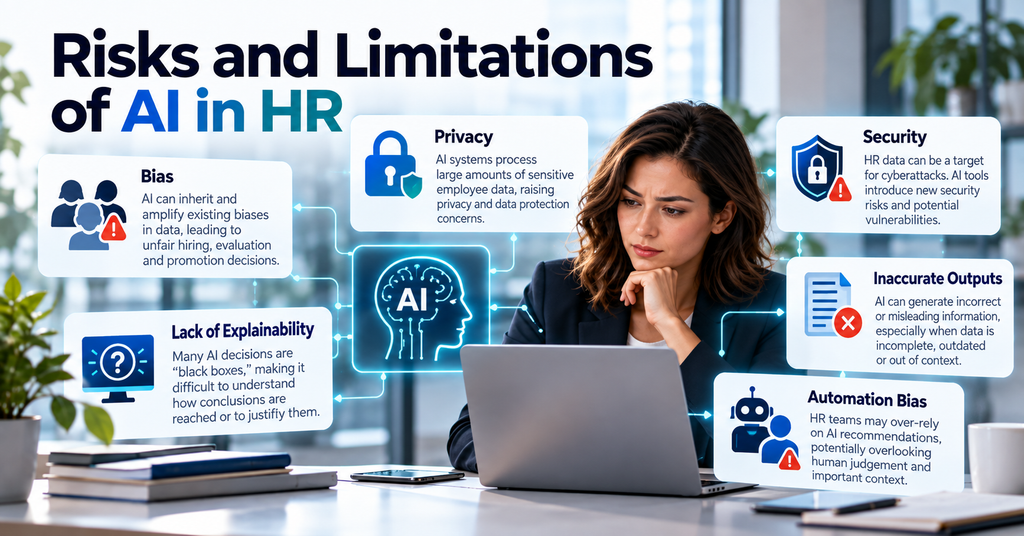
HR applications deserve greater scrutiny than many low-stakes productivity tools because errors can affect people’s careers, income, benefits, and opportunities.
Important risks include bias, discrimination, privacy failures, cybersecurity problems, inaccurate data, misleading outputs, lack of explainability, automation bias, excessive employee surveillance, poor accountability, and model or data changes over time.
AI can also remove context by converting complex human situations into measurable variables. NIST specifically notes that representing complex human phenomena mathematically can cause relevant context to be lost.
Algorithmic Bias in Hiring
AI is not inherently unbiased or inherently discriminatory.
Problems can arise from historical hiring data, training data, proxy variables, selection criteria, system design, or how employers deploy and interpret a model.
NIST notes that human assumptions and cognitive biases can enter AI systems throughout their lifecycle.
The more accurate conclusion is that automated systems can produce unfair or discriminatory outcomes depending on their data, design, deployment, and oversight—and human decision-making can contain bias as well.
What U.S. Employers Should Know About AI Hiring
U.S. employers should not assume that AI hiring operates outside existing employment rules simply because a decision involves software.
Automated tools can interact with existing anti-discrimination, employment, privacy, disability, and local regulatory requirements. The precise obligations depend on the jurisdiction, type of tool, and way the employer uses it.
There is not one universal federal “AI hiring law” governing every possible tool and employer in exactly the same way.
New York City’s Automated Employment Decision Tool Rules
New York City’s Local Law 144 provides a concrete example.
For covered automated employment decision tools, NYC’s Department of Consumer and Worker Protection states that employers and employment agencies may not use an AEDT unless it has undergone a bias audit within the previous year, information about that audit is publicly available, and required notices are provided to candidates or employees. Enforcement began July 5, 2023.
That does not mean every HR chatbot, scheduling tool, or AI application automatically qualifies as an AEDT. Applicability depends on the tool and its role in an employment decision.
AI in HR and the EU AI Act
The EU AI Act treats certain employment-related uses as particularly sensitive. Annex III covers systems intended for uses such as recruitment or selection, including analyzing applications and evaluating candidates.
An important timeline change occurred in 2026.
Following the AI Omnibus changes, the high-risk requirements for Annex III systems—including relevant employment uses—are scheduled to apply from December 2, 2027, rather than the previously expected August 2026 timetable. High-risk systems embedded in regulated products move to August 2, 2028.
Employers operating in the EU should evaluate their particular system and use case rather than assuming that every HR application receives the same classification.
Why Human Oversight Matters
Human oversight means more than automatically approving whatever an algorithm recommends.
A responsible reviewer should be able to:
- understand the tool’s intended role;
- question its output;
- consider information the system missed;
- identify errors;
- override a recommendation;
- understand escalation procedures;
- document who remains responsible.
NIST’s AI Risk Management Framework is a voluntary risk-management framework, not an employment law. Its core functions are Govern, Map, Measure, and Manage, and its guidance emphasizes clearly defined responsibilities and risk management throughout an AI system’s lifecycle.
How Businesses Should Evaluate an AI HR Tool
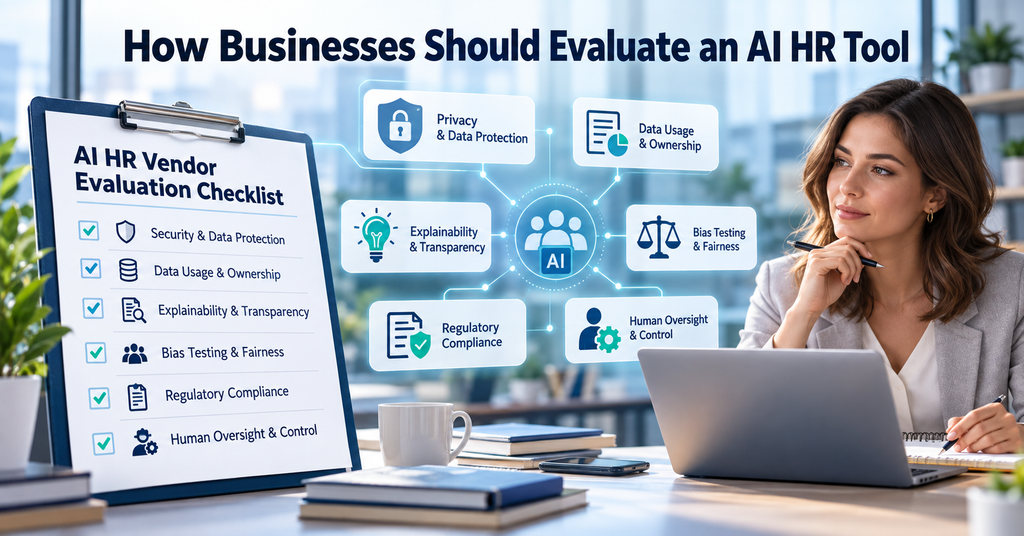
Before purchasing or deploying an AI HR system, ask:
- What exact HR problem does it solve?
- Who developed it?
- Is the vendor identifiable?
- What information does it collect?
- Why does it need that data?
- Where is employee data stored?
- Is customer data used for model training?
- What access controls exist?
- Can important outputs be explained?
- How is bias evaluated?
- Where is human review required?
- Can an affected person challenge an outcome?
- What compliance documentation is available?
- What happens when the model is wrong?
- Has system performance been independently validated?
- How will the organization measure success or ROI?
This type of due diligence matters more than whether a vendor uses fashionable phrases such as “AI-powered.”
What to Verify Before Trusting a Product Called HRMtaila
If a real product using the HRMtaila name appears in the future, buyers should look for concrete evidence including an identifiable company, official domain, named leadership where appropriate, privacy policy, terms of service, security documentation, data-processing information, product documentation, support contacts, pricing or sales information, integrations, and independent customer evidence.
The issue is not that the word HRMtaila is inherently unsafe. The issue is that an established product identity has not yet been verified.
Does HRMtaila Have Pricing?
No verified HRMtaila pricing structure was identified.
Generic prices for HR software should not be relabeled as “HRMtaila pricing,” and there is no evidence supporting invented Free, Professional, Business, or Enterprise tiers.
Does HRMtaila Have an App or Download?
No verified official HRMtaila mobile application or authenticated software download was established during this research.
Users should avoid treating an unrelated APK, installer, browser extension, or download page as official solely because it uses the keyword.
Does HRMtaila Have a Login?
No verified official HRMtaila customer login portal was identified.
Search demand for “HRMtaila login” does not prove that an account-based service exists.
Who Owns HRMtaila?
No verified company or owner has been clearly identified behind the term.
Likewise, this research found no reliable basis for naming a founder, CEO, headquarters, funding history, or country of origin.
Is HRMtaila Legit?
There is currently too little verified product and company evidence to conduct a conventional legitimacy review of HRMtaila.
The distinction is important: AI-assisted HR technology is real and widely documented. That does not establish the existence or legitimacy of a particular commercial product named HRMtaila.
HRMtaila: Verified Facts vs. Online Claims
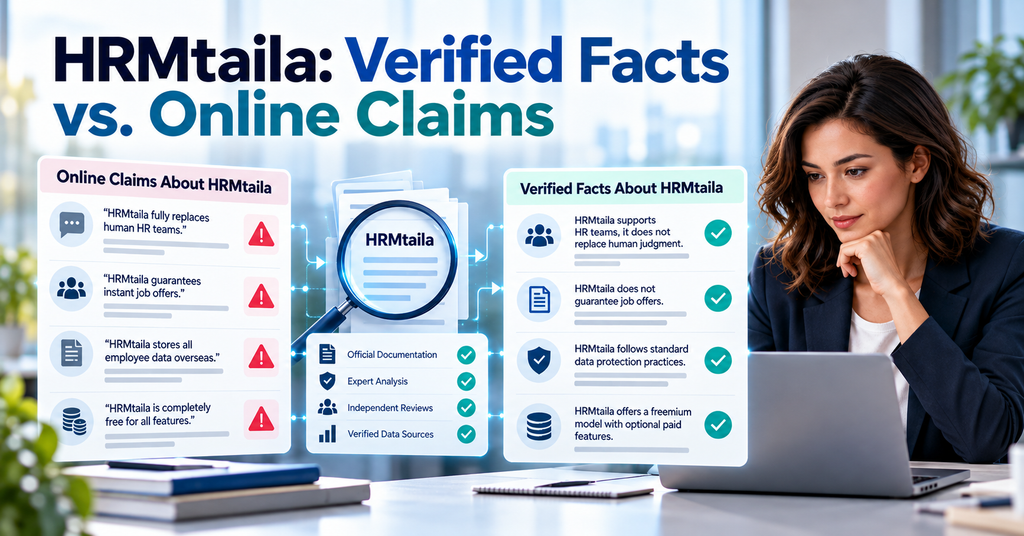
| Claim | Current evidence | Status |
| HRMtaila appears in AI/HR articles | Numerous September 2026 results found | Supported |
| HRM commonly means Human Resource Management | Established terminology | Supported |
| HRMtaila is an established software company | No authoritative company evidence verified | Unverified |
| HRMtaila offers recruitment automation | Commonly associated in articles, no official product docs | Not verified as a feature |
| HRMtaila offers payroll | No official feature documentation identified | Unverified |
| HRMtaila has workforce analytics | Broader AI-HR capability, not proven HRMtaila feature | Unverified |
| HRMtaila has pricing | No verified official pricing page | Unverified |
| HRMtaila has an app | No verified official app established | Unverified |
| HRMtaila has a founder | No verified founder identified | Unverified |
| AI is being used in HR in 2026 | Supported by SHRM research | Verified broader trend |
Why Are So Many HRMtaila Articles Similar?
Many visible articles discuss the same cluster of concepts: recruitment, onboarding, workforce analytics, payroll administration, employee support, privacy, bias, and automation.
That similarity does not prove copying or coordinated publication.
One reasonable explanation is simply that an undefined term linked to “AI + HR” naturally leads writers toward the same limited group of established AI-in-HR use cases.
Without direct evidence, stronger claims about copying, AI-generated networks, or the original creator should be avoided.
Is HRMtaila an Industry Standard?
Current evidence does not establish HRMtaila as a recognized HR or AI standard.
It should not be confused with broader, established concepts such as human resource management, AI in HR, algorithmic hiring, or AI risk management.
Is HRMtaila the Future of HR?
AI and automation are becoming more visible in human resources, but there is no evidence that the specific term HRMtaila will become a recognized technology category, industry framework, or widely adopted product.
SHRM’s 2026 findings demonstrate real adoption of AI in recruitment, HR technology, and learning and development.
That supports the future relevance of AI in HR, not a prediction about the future of the HRMtaila keyword.
Conclusion
HRMtaila currently appears to be an emerging online term associated with AI-assisted human resource management rather than a clearly documented software company, application, or recognized HR standard.
Its visible search footprint is recent, its original creator remains unverified, and no authoritative evidence currently establishes official pricing, an app, a login portal, ownership, or a defined product feature set.
The broader technology associated with the term is real. Organizations are already using AI for recruitment, HR technology, learning, workflow automation, and employee support. Those applications also introduce meaningful questions around bias, privacy, accuracy, accountability, and human oversight.
If a commercial HRMtaila product emerges, its claims should be evaluated against primary company, product, privacy, security, and customer evidence.
FAQ’s
What is HRMtaila?
HRMtaila is an emerging online term associated with AI-assisted human resource management, HR automation, recruitment, employee support, and workforce analytics. Current evidence does not establish it as a specific commercial software platform, identifiable company, or recognized HR standard.
What does HRMtaila mean?
The “HRM” portion reasonably corresponds to Human Resource Management because the term appears almost entirely in HR and AI discussions. No authoritative creator has published a verified expansion of the full word, so the remaining letters should not be converted into a speculative acronym.
Is HRMtaila real software?
There is currently insufficient authoritative evidence to describe HRMtaila as established commercial software. No confirmed product documentation, vendor identity, pricing, customer base, integrations, or software-support infrastructure was verified.
Is HRMtaila an AI platform?
HRMtaila is frequently associated online with AI in human resources, but that does not establish a specific AI platform. AI recruitment, employee assistants, automation, and workforce analytics are real technology categories independent of the HRMtaila term.
What is HRMtaila used for?
No verified product usage can currently be assigned to HRMtaila. Articles discussing the term associate it with broader applications such as recruitment, onboarding, employee support, analytics, and HR automation. Those are general AI-HR use cases rather than confirmed HRMtaila features.
Does HRMtaila have an official website?
No authoritative official product or company website was verified during this research. Websites publishing articles about HRMtaila should not automatically be treated as the official source for the term.
Does HRMtaila have pricing?
No verified pricing page or commercial pricing structure was identified. Generic HR software costs should not be presented as HRMtaila prices.
Is there an HRMtaila app?
No verified official HRMtaila application was established. Users should independently verify the developer and official company identity before trusting any future download that uses the name.
Who owns HRMtaila?
No verified owner, founder, CEO, or company has been clearly identified behind the term. Assigning ownership without primary evidence would be speculative.
Can AI make hiring decisions?
AI can support parts of recruitment, but employment decisions may create significant fairness and legal risks. For example, New York City’s Local Law 144 imposes specific requirements on covered automated employment decision tools, including bias audits and notices.
