

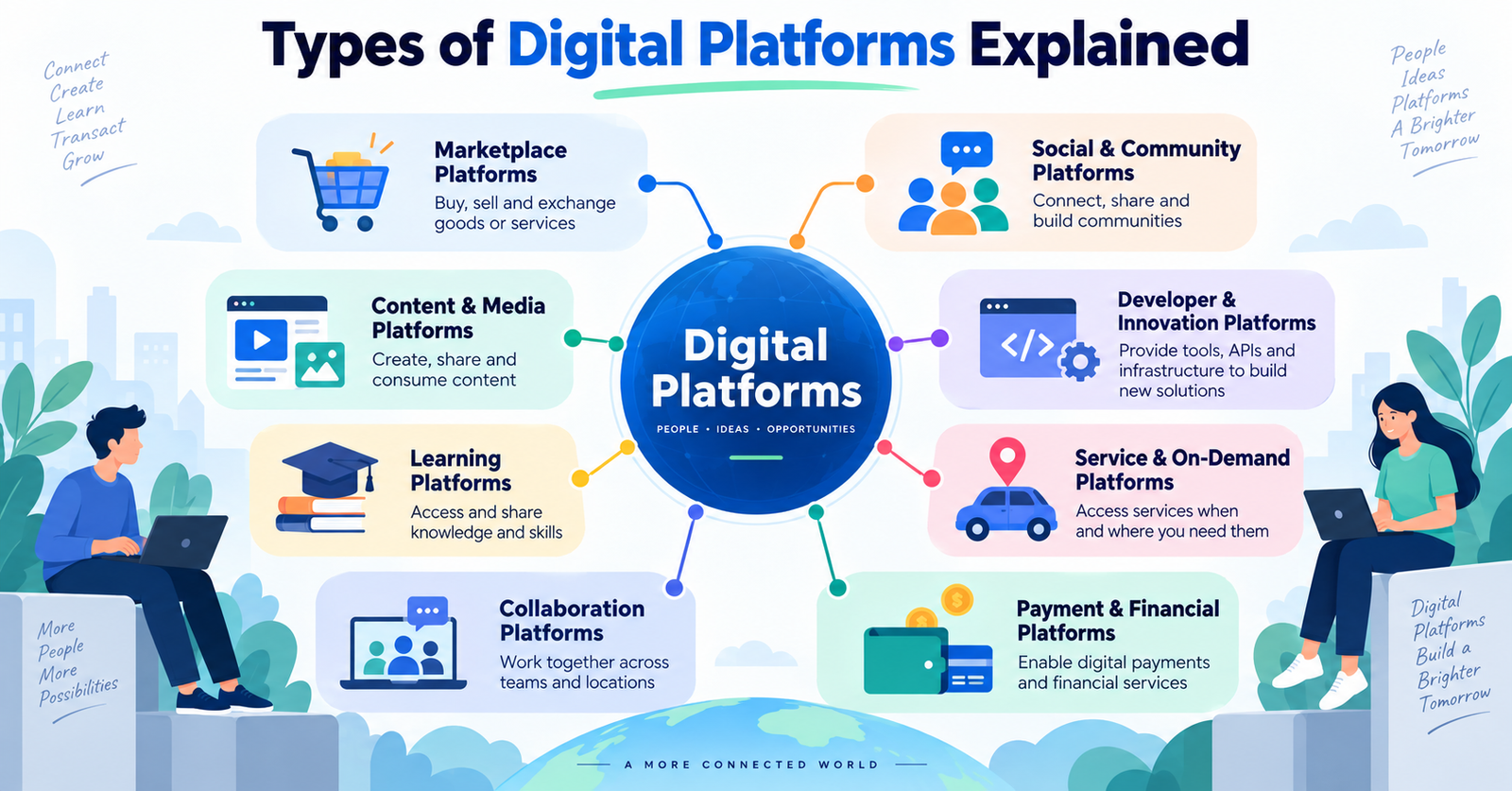
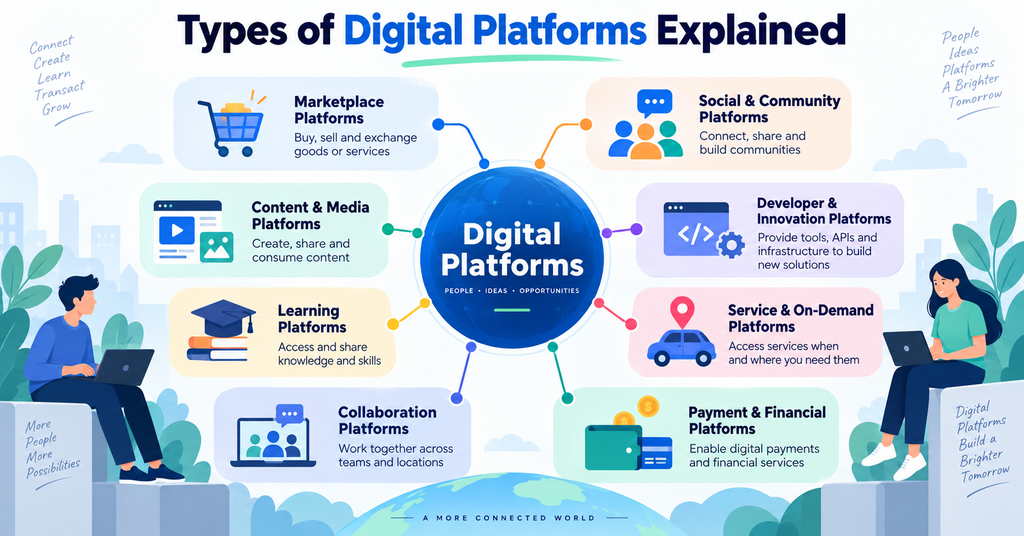
Digital platforms are everywhere, but classifying them is surprisingly difficult. Search for types of digital platforms and one source may give you three categories, another five, and another ten.
That does not necessarily mean one list is wrong.
There is no single universally accepted number of digital platform types. Researchers and businesses classify platforms according to different questions: how users interact, what is exchanged, whether outside developers can build on the system, what industry the platform serves, or how the platform creates value.
For example, a 2024 Information Systems Journal study synthesizes earlier literature into transaction, innovation, and community platforms, while other research uses substantially more detailed classifications.
This guide explains both the underlying research and a practical way to recognize the major digital platform types you encounter today.
What Is a Digital Platform?
A digital platform is a technology-enabled environment that supports interactions, exchanges, services, or value creation among users, businesses, developers, creators, or other participants.
Depending on its purpose, a platform may help people buy and sell products, communicate with a community, publish content, build applications, coordinate work, learn new skills, process payments, or access technology infrastructure.
In platform-business research, the definition is often narrower. Harvard Business School Online describes digital platforms as business models using online infrastructure to facilitate interactions between groups.
Technology research uses the term more broadly because operating systems and cloud environments can also function as platforms on which others build.
Why Are There Different Lists of Digital Platform Types?
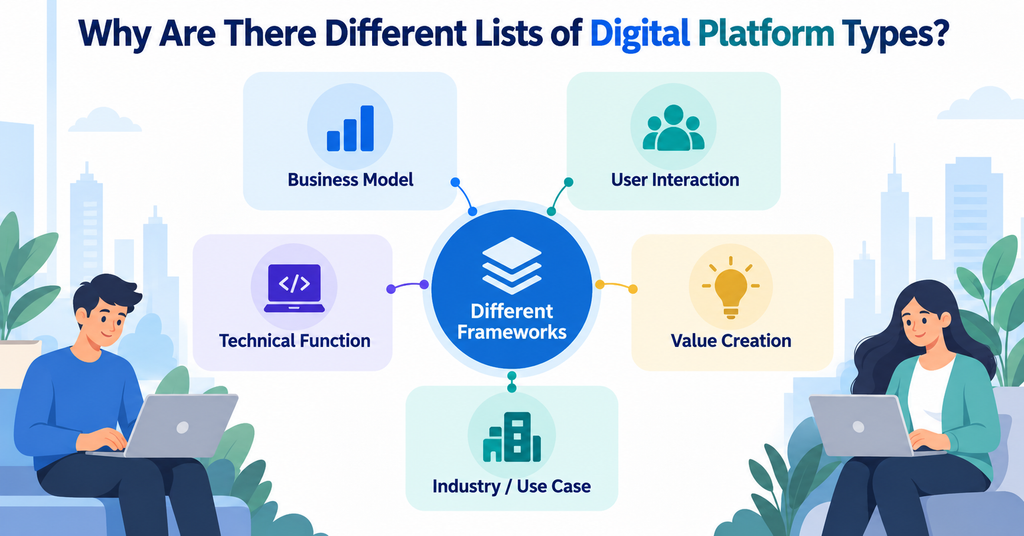
The easiest answer is that researchers are classifying different characteristics.
Someone studying platform economics may ask:
How does this system create value?
That can produce categories such as transaction, innovation, and community.
Someone studying an industry may ask:
What is the platform used for?
That produces categories such as education, healthcare, finance, travel, and gaming.
A software researcher might instead ask:
What technological foundation does this platform provide?
That brings operating-system, developer, and cloud platforms into focus.
All three approaches can be useful. They simply answer different questions.
Platform Business Model vs Technology Platform
This distinction prevents a major source of confusion.
A platform business model primarily creates value by coordinating interactions between participants.
An innovation or technology platform provides a common technological foundation upon which other parties can develop complementary products or services.
Amazon Marketplace illustrates transaction logic because independent sellers can offer goods to customers through Amazon. Android illustrates innovation-platform logic because developers build applications for the Android ecosystem.
Some ecosystems combine both roles.
Types of Digital Platforms at a Glance
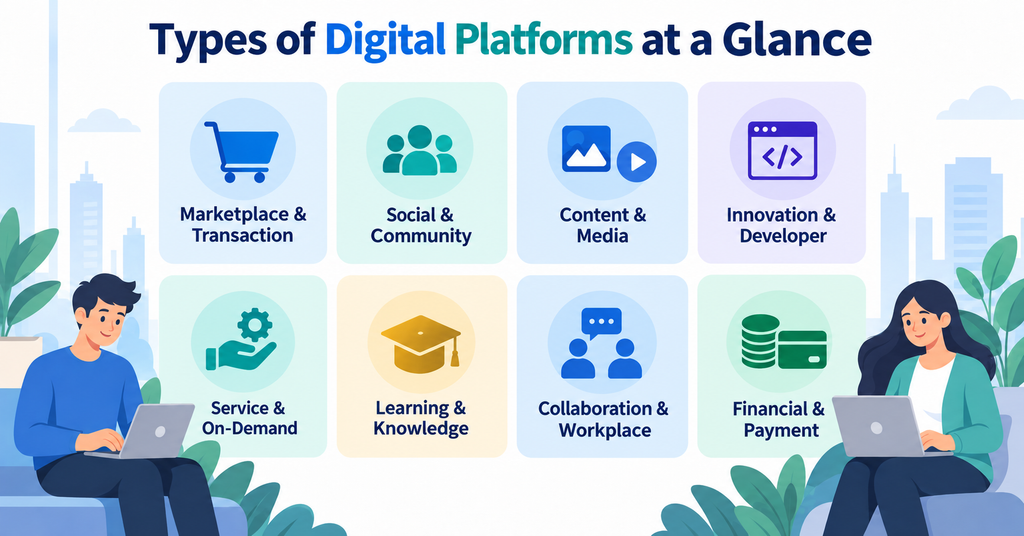
One practical way to group modern digital platforms is:
- marketplace and transaction platforms;
- social and community platforms;
- content and media platforms;
- innovation and developer platforms;
- service and on-demand platforms;
- learning and knowledge platforms;
- collaboration and workplace platforms;
- financial and payment platforms.
These eight groups are an editorial framework for understanding common platform functions—not eight “official” categories.
1. Marketplace and Transaction Platforms
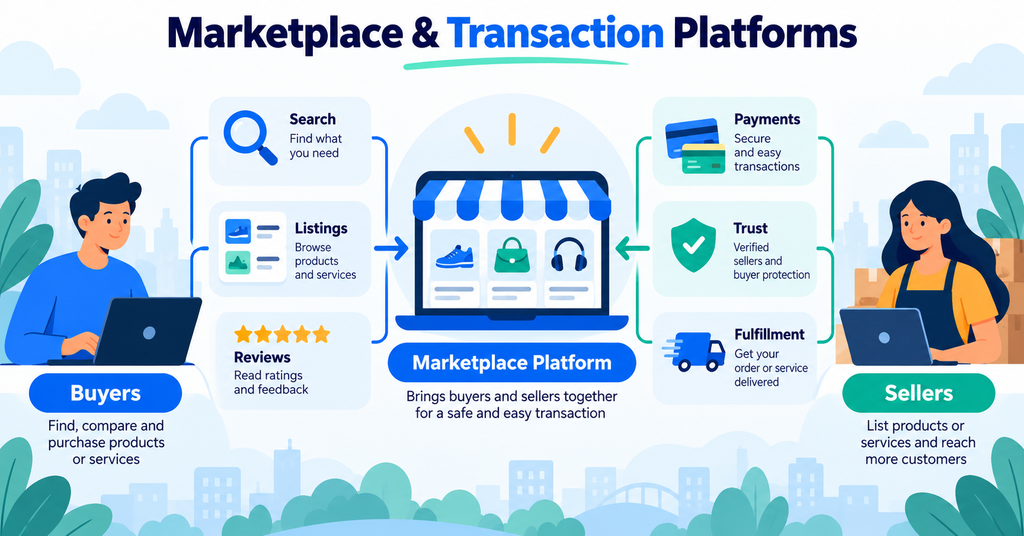
Marketplace or transaction platforms help different participant groups discover one another and exchange value.
That value might involve products, accommodation, transport, digital goods, services, or even access rather than a conventional retail purchase.
Typical features include:
- search;
- listings;
- matching;
- payment tools;
- reviews;
- ratings;
- reputation mechanisms.
Amazon Marketplace is a useful example. Amazon’s current Seller Central documentation distinguishes independent third-party sellers who offer products through Amazon’s store from first-party vendor relationships.
The important point is that the platform coordinates interactions between distinct participant groups.
A transaction does not always need to mean purchasing a physical product. Matching and access can also be part of the exchange.
2. Social and Community Platforms
Social and community platforms derive substantial value from communication, user contribution, relationships, or shared interests.
Common features include:
- user profiles;
- posts;
- comments;
- groups;
- feeds;
- voting or reactions;
- moderation systems.
Reddit is a clear community example because its service remains organized around topic-based communities, commonly called subreddits.
However, social and community categories overlap. A social platform may also sell advertising, operate creator programs, or provide developer tools.
Its primary classification should therefore reflect its main value-creation role rather than every feature it offers.
3. Content and Media Platforms
Content platforms help creators, publishers, or media providers distribute material to audiences.
That content can include:
- video;
- music;
- podcasts;
- images;
- articles;
- livestreams.
Examples include services such as YouTube and Spotify.
These platforms frequently overlap with community and transaction models. A video platform may have comments and creator communities, while a streaming service may rely heavily on subscriptions.
That does not require creating a new platform type for every feature.
4. Innovation and Developer Platforms
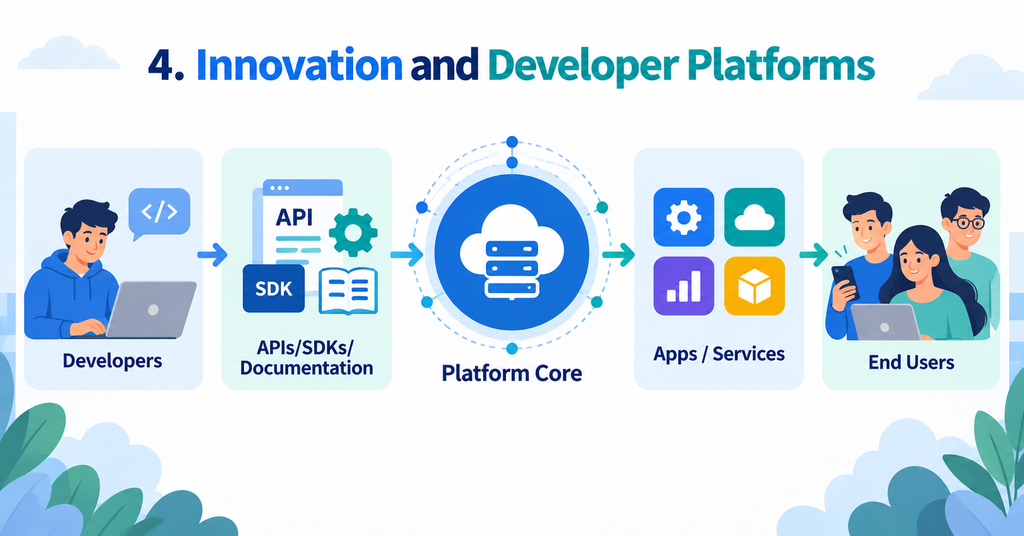
Innovation platforms provide a technological core upon which external developers or organizations create complementary applications, services, tools, or extensions.
Typical platform resources can include:
- APIs;
- SDKs;
- developer documentation;
- reusable services;
- operating-system capabilities;
- application distribution systems.
Android is a strong example. Google continues to provide Android development tools, APIs, platform releases, and an application-development ecosystem.
The outside developers who create complementary products are often called complementors.
A simplified relationship looks like:
Platform core → developers/complementors → applications/services → users
Not every piece of SaaS software with an API should automatically be called an innovation platform. The ecosystem role matters.
5. Service and On-Demand Platforms
On-demand platforms coordinate customers who need a service with providers capable of delivering it.
Common areas include:
- transportation;
- accommodation;
- food delivery;
- freelance work;
- local services.
Uber is a straightforward example. Its current documentation explicitly describes the technology as matching riders with drivers.
From an academic perspective, Uber can also be classified as a transaction platform.
That overlap is important: “on-demand service platform” describes a practical use case, whereas “transaction platform” describes the broader value-creation mechanism.
6. Learning and Knowledge Platforms
Learning platforms organize structured instruction.
They may provide:
- courses;
- lessons;
- assessments;
- certificates;
- degrees;
- instructor tools.
Coursera, for example, currently describes itself as a global online learning platform offering courses and degrees from universities and companies.
Knowledge platforms work somewhat differently. Their primary value may come from questions, answers, documentation, or community-generated expertise rather than formal courses.
A platform can contain both functions, but distinguishing them improves clarity.
7. Collaboration and Workplace Platforms
Collaboration platforms help people coordinate work.
Their functions can include:
- team messaging;
- voice or video communication;
- file sharing;
- workflow coordination;
- project visibility;
- application integrations.
Slack describes its product as a collaboration platform for teams and businesses, combining communication with integrations and other work tools.
From a strict platform-economics perspective, products in this group may sometimes be better described as collaboration software rather than multi-sided platform businesses.
“Collaboration platform” is therefore primarily a practical technology category.
8. Financial and Payment Platforms
Payment and financial platforms provide digital infrastructure for moving money or coordinating transactions among merchants, customers, financial institutions, and other systems.
Functions may include:
- payment acceptance;
- checkout;
- payouts;
- recurring billing;
- fraud tools;
- financial APIs.
Stripe currently describes itself as a financial infrastructure platform for businesses, while PayPal markets an integrated platform for accepting and managing payments.
However, “financial platform” is often an industry/use-case description rather than a fundamental category in platform economics.
Not every online bank is automatically a multi-sided platform.
How Researchers Classify Digital Platforms
Practical categories help readers recognize platforms, but academic studies often classify them according to deeper mechanisms.
A 2024 Information Systems Journal synthesis identifies three broad types:
Transaction Platforms
These help two or more groups find one another, interact, and exchange value.
Examples include marketplaces and ride-hailing services.
Innovation Platforms
These provide a reusable technical foundation for external innovators to create complementary products or services.
Operating systems such as Android are strong examples.
Community Platforms
These derive important value from interaction among community participants and the information or content they contribute.
These three types are useful because they describe how value is created, rather than the industry in which the platform operates.
The Doligalski Four-Type Framework
Another framework studies multi-sided platforms and virtual communities through three dimensions: user collaboration, reputation-based competition, and multi-sidedness.
Its infographic identifies:
Problem Community — discussion and discourse among users.
Product Community — users publish content objects and others interact with them.
Product Market — one group posts opportunities or objects for another group, often to enable matching.
Reputation Market — structured buyer/seller marketplaces where reputation and reviews strongly shape repeated transactions.
The four categories should not be interpreted as the four universal forms of every digital platform. They were derived from analysis of 69 multi-sided platforms and virtual communities.
What Is a Hybrid or Integrated Platform?
Real platforms rarely remain inside perfect category boundaries.
Evans and Gawer use the term integrated platform for a system combining transaction-platform and innovation-platform characteristics.
An ecosystem can simultaneously enable transactions and support outside developers.
That is why assigning a platform one category should normally mean identifying its primary mechanism, not denying that other mechanisms exist.
Why Digital Platforms Can Be Classified in Different Ways
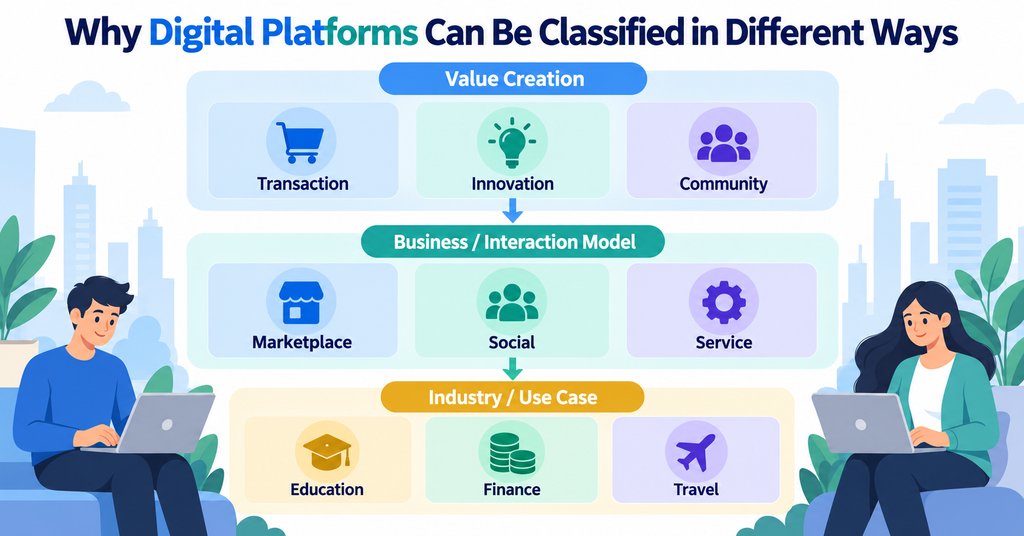
A useful way to visualize the issue is through three classification levels.
1: Value-Creation Model
- Transaction
- Innovation
- Community
2: Interaction or Business Model
- Marketplace
- Social
- Service
- Labour
- Content
3: Industry or Use Case
- Ecommerce
- Education
- Finance
- Healthcare
- Travel
- Gaming
A fourth technological layer can include operating systems, cloud infrastructure, and developer platforms.
This explains how apparently different lists can all be legitimate.
Are Cloud Platforms a Separate Type?
They can be—when the taxonomy is technological.
AWS, Microsoft Azure, and Google Cloud are commonly described as cloud computing platforms.
AWS defines cloud computing as on-demand delivery of compute power, databases, storage, applications, and other IT resources through a cloud-services platform.
That makes “cloud platform” a strong technology classification.
It is not the same classification level as “community platform” or “marketplace.”
Is SaaS a Type of Digital Platform?
Not automatically.
SaaS—software as a service—primarily describes how software is delivered and accessed.
A SaaS product might be:
- a standalone application;
- collaboration software;
- an innovation platform;
- marketplace infrastructure;
- a business platform.
The delivery method alone does not determine its platform role.
Is Every Ecommerce Website a Digital Platform?
No.
A retailer selling only its own products through its website can primarily be described as an ecommerce website.
A marketplace that connects many independent sellers with buyers more clearly demonstrates transaction-platform characteristics.
Meanwhile, software such as Shopify can provide commerce technology upon which merchants build their own stores.
These are related but architecturally different models.
Digital Platform vs Website
A website is usually a web-accessible destination or interface containing pages and functionality.
A platform normally supports a deeper system of recurring interactions, workflows, transactions, data exchange, services, or ecosystem participation.
However, the terms are not mutually exclusive.
A digital platform can be accessed through a website, and a sophisticated website can contain platform functionality.
What should be avoided is claiming that every website is automatically a digital platform.
Digital Platform vs Digital Channel
A digital channel primarily carries communication or helps an organization reach people.
Examples include:
- email;
- SMS;
- display advertising.
A platform can support a much broader environment of users, services, data, workflows, interactions, transactions, and governance.
Therefore a digital channel should not automatically be classified as a platform.
Revenue Models Are Not Platform Types
Subscription, advertising, commission, transaction fees, freemium, and usage-based pricing describe how revenue is generated.
They do not necessarily describe what type of platform something is.
For example, both a content platform and a collaboration platform may sell subscriptions.
Similarly, advertising can support both a search platform and a social platform.
This distinction prevents revenue models from being mistaken for platform taxonomies.
How Network Effects Differ by Platform Type
Platform discussions often mention network effects, but they do not work identically everywhere.
A transaction platform, more relevant sellers can make the platform more attractive to buyers, while additional buyers can attract sellers.
For an innovation platform, more useful complementary applications may make the underlying technology more valuable.
For a community platform, additional knowledgeable or relevant participants can create more useful interactions or content.
More participants do not automatically mean a better platform. Spam, congestion, low-quality supply, and moderation problems can reduce value.
Platform Governance
Platforms normally need rules covering at least some combination of:
- participant access;
- transactions;
- content;
- developer access;
- moderation;
- reviews;
- pricing;
- data use.
Governance varies considerably according to platform type.
A developer platform may concentrate heavily on APIs and technical rules, while a marketplace may focus more on seller standards, payments, disputes, and trust.
How to Identify a Digital Platform Type
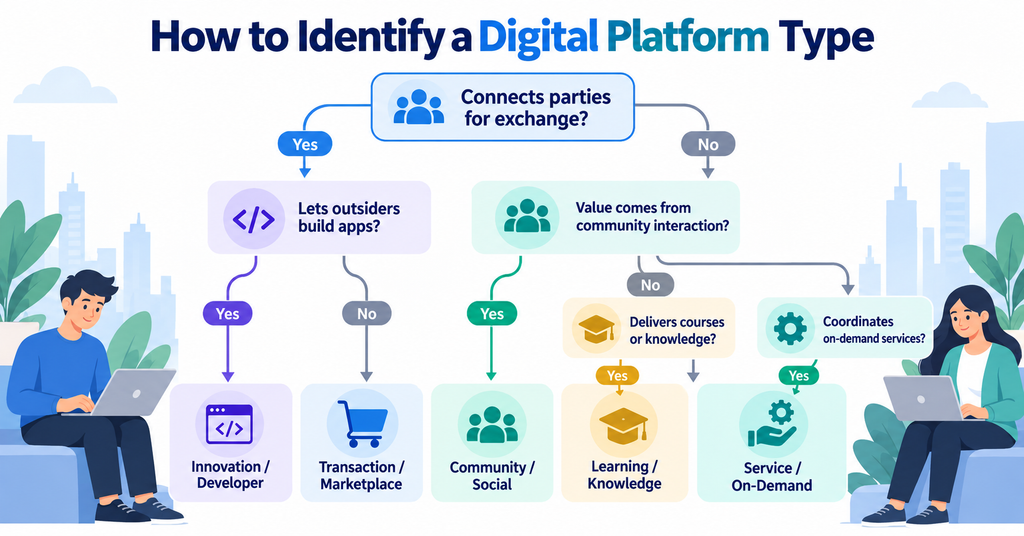
Ask what the platform primarily enables.
Does it connect independent parties so they can exchange value?
It likely has transaction or marketplace characteristics.
Does it provide a technical core upon which outsiders build products?
It likely has innovation/developer characteristics.
Does most of its value come from user interaction or user-generated contributions?
Community/social classification may fit.
Does it coordinate customers and service providers?
It can be described practically as an on-demand service platform and more broadly as a transaction platform.
Does it mainly deliver structured education?
Learning platform is a useful use-case label.
Does it provide cloud infrastructure?
Cloud or technology platform may be the most appropriate classification.
Some platforms will lead to more than one answer. That is normal.
Benefits and Challenges of Digital Platforms
Digital platforms can help reduce search and matching friction, extend access to services, reuse shared infrastructure, coordinate ecosystems, and enable interactions at scale.
They also create challenges involving:
- trust;
- privacy;
- security;
- governance;
- moderation;
- participant dependence;
- platform rules;
- regulatory compliance;
- technical complexity.
The effect depends on implementation and the type of platform involved.
Why Knowing the Platform Type Matters
Classification is more than terminology.
Different platform structures create different operating problems.
A marketplace may need to balance buyers and sellers.
A community may need strong moderation.
A developer platform must think about APIs, compatibility, documentation, and complementors.
A financial platform faces payment-security and infrastructure requirements.
Understanding the underlying type therefore helps readers analyze how the system creates value, which participants matter, and what operational challenges deserve attention.
Final Takeaway
There is no universal fixed number of digital platform types.
Research frameworks frequently classify platforms according to how they create value, while practical business sources categorize them according to function or industry.
A useful academic starting point is transaction, innovation, and community platforms. A practical modern view can additionally describe marketplaces, social communities, content platforms, developer ecosystems, on-demand services, learning platforms, workplace platforms, and financial platforms.
The most accurate question is therefore not simply, “How many types are there?”
It is:
“What classification system are we using, and what aspect of the platform are we trying to understand?”
FAQs
How many types of digital platforms are there?
There is no universally fixed number. A 2024 academic synthesis uses transaction, innovation, and community platforms, while other frameworks classify platforms using different criteria. The number depends on what is being analyzed.
What are the three main academic types of digital platforms?
A useful recent academic synthesis identifies transaction, innovation, and community platforms.
What is a transaction platform?
It helps participant groups find one another, interact, and exchange value. Marketplaces and ride-hailing services are common examples.
What is an innovation platform?
It supplies a technological foundation upon which outside developers or organizations build complementary applications, products, or services.
Is social media a digital platform?
Yes. Social media is a widely recognized practical form of digital platform, normally centered on communication, content, and relationships.
Is Amazon a digital platform?
Different Amazon products perform different roles. Amazon Marketplace is the more precise transaction-platform example because it connects third-party sellers with buyers.
Is a website a digital platform?
Not automatically. A simple informational website may have little platform functionality, whereas a web-based system that enables recurring interaction, transactions, workflows, or an ecosystem may operate as a digital platform.
Is SaaS a digital platform?
Not necessarily. SaaS describes software delivery. Whether a SaaS application functions as a platform depends on its architecture, participants, ecosystem role, and capabilities.
Are cloud platforms digital platforms?
Yes in a technological classification. Cloud services such as AWS provide shared infrastructure including compute, storage, databases, and application services.
What is an integrated platform?
In the Evans-Gawer framework, it combines transaction and innovation-platform characteristics.
