

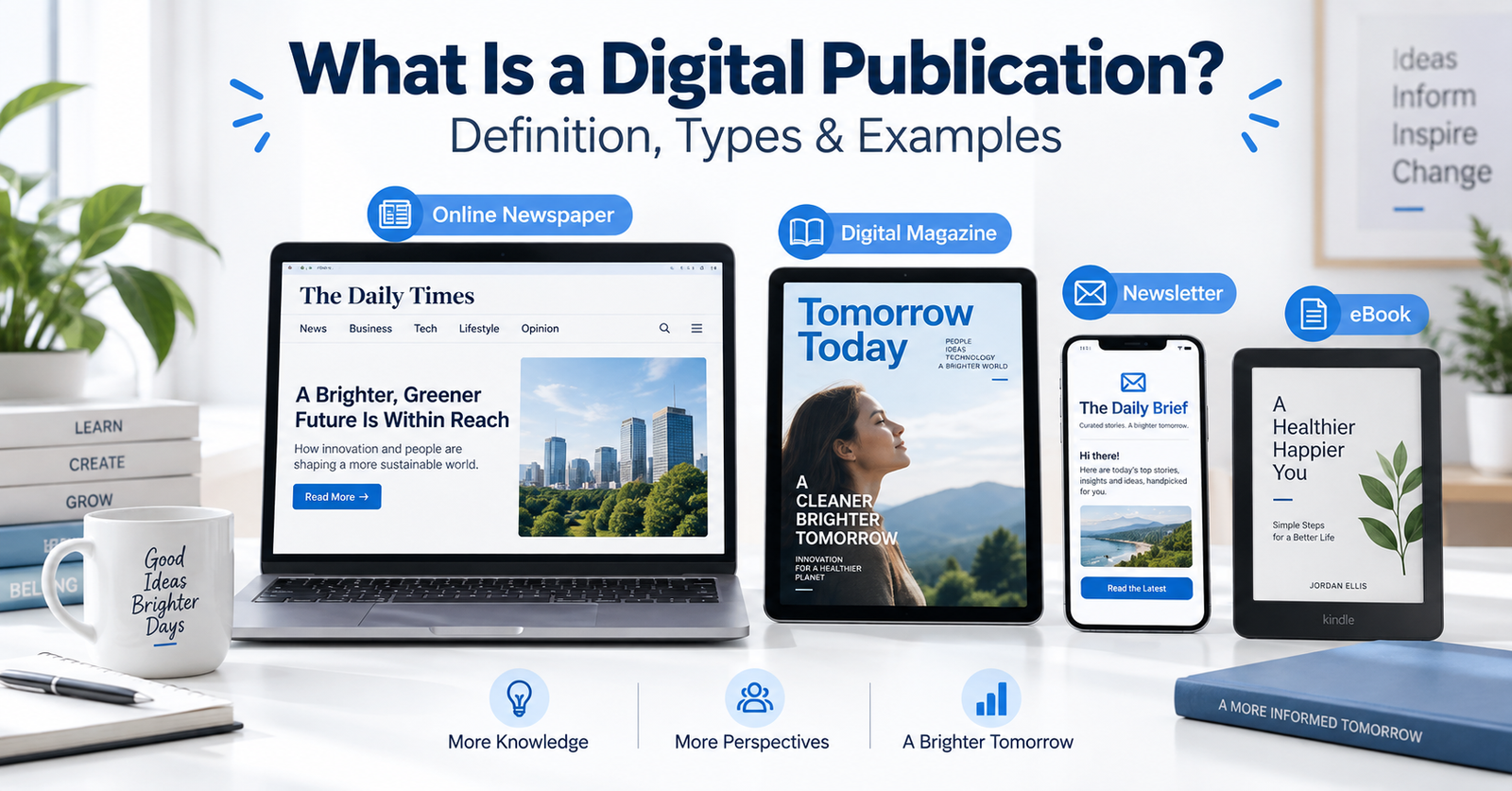
A digital publication is an organized work that is published and distributed electronically so people can read, view or sometimes interact with it on a digital device. eBooks, digital magazines, online newspapers, reports, journals, catalogs and newsletters are common examples. They may be delivered as PDFs, EPUB files, web-based publications, apps or interactive browser experiences.
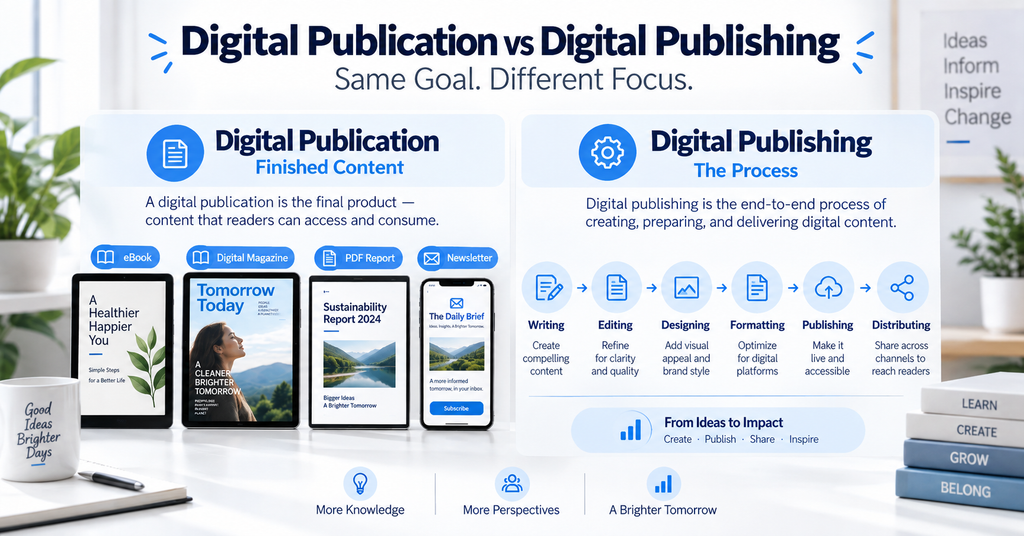
The important distinction is that a digital publication is the finished content. while digital publishing is the process used to create and distribute that content.
What Is a Digital Publication?
A digital publication is content that has been prepared and released in an electronic format for an intended audience.
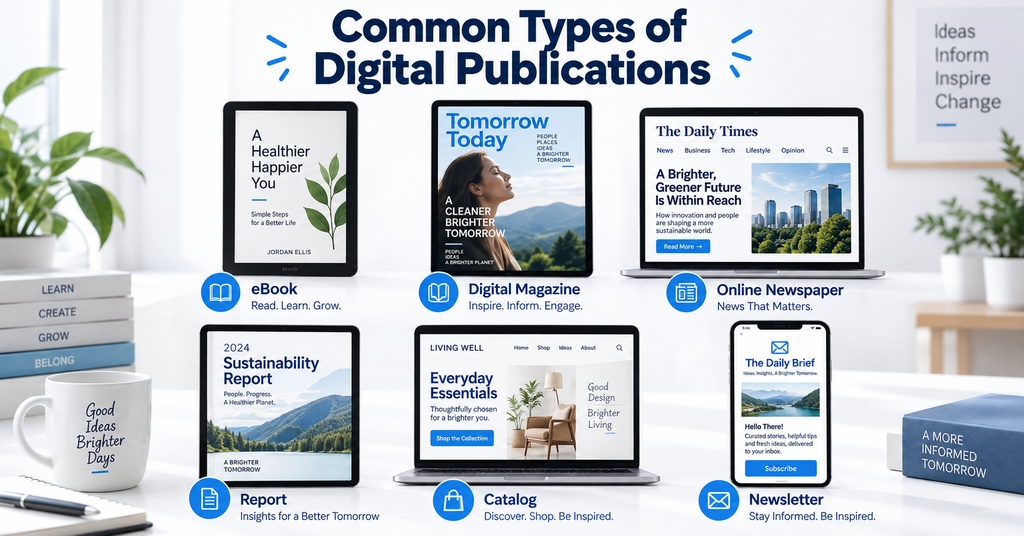
The term can cover many different kinds of work, including books, magazines, reports, catalogs, academic journals, brochures and recurring editorial newsletters.
A publication may be downloadable or browser-based. It may use a fixed page layout or allow text to reflow according to screen size. It can be completely static or contain links, audio, video, animation, forms and other interactive elements.
Interactivity, however, is not a requirement.
W3C publishing guidance uses the term broadly for publications produced in digital formats and specifically recognizes formats including EPUB and PDF.
Digital Publication vs Digital Publishing
These terms sound similar but describe different things.
A digital publication is the finished product readers access.
Examples include:
- an EPUB eBook;
- a PDF annual report;
- a digital magazine;
- a research journal;
- an online catalog.
Digital publishing is the process or business involved in preparing and distributing that material.
It may involve writing, editing, design, formatting, publishing, distribution, updating, monetization and performance measurement.
Oxford similarly describes digital publishing as the business of publishing materials in forms readable on computers, e-readers and other digital devices.
A simple way to remember the distinction is:
Publication = the finished work.
Publishing = the process that produces and distributes it.
What Makes Something a Digital Publication?
Not every digital file should automatically be described as a digital publication.
A publication normally involves several ideas:
- organized content;
- preparation for an audience;
- intentional release or distribution;
- an identifiable structure or purpose;
- access through digital technology.
A random photograph saved on a laptop is digital content, but it is not necessarily a digital publication.
Similarly, a private invoice stored as a PDF is a digital document without necessarily being a publication.
The exact definition can also change slightly according to publishing, library, auditing or technical contexts, so there is no need to force every digital object into one rigid classification.
Common Types of Digital Publications
eBooks
An eBook is a book distributed in digital form.
Common formats include EPUB and PDF, although publishers and reading ecosystems may use other formats as well.
EPUB is particularly important because its content can often reflow to fit different screen sizes and reader settings. W3C defines EPUB as a distribution and interchange format for digital publications and documents and describes it as capable of packaging structured web content into a single-file container.
Not every eBook is an EPUB, however.
Digital Magazines
A digital magazine may be:
- a downloadable PDF;
- a flipbook;
- an app-based edition;
- a fixed-layout publication;
- a responsive web publication.
A digital magazine therefore should not be defined simply as a flipbook.
Modern magazine experiences can include responsive layouts, video, audio, interactive navigation and analytics, but these features depend on the format and publishing system being used.
Online Newspapers and Digital Journals
Newspapers can publish digitally through websites, apps, subscriber e-editions or downloadable editions.
Academic and professional journals commonly distribute articles through HTML and PDF, while other formats may also be available.
A newspaper website and a digital replica edition are not technically identical, even though both belong to a publisher’s digital offering.
Reports and White Papers
Businesses, universities, governments and other organizations frequently release annual reports, research reports, industry studies and white papers digitally.
They may use PDF, HTML or interactive web presentations.
This is one of the clearest everyday examples of digital publication.
Digital Catalogs and Brochures
Catalogs and brochures may be simple downloadable PDFs or more interactive online experiences.
Depending on the system, they can contain product links, search, video, forms or purchase links.
Those features are optional. A straightforward PDF catalog can still be a digital publication.
Digital Newsletters
An editorial newsletter distributed by email or through a newsletter platform can also function as a digital publication, particularly when it is issued regularly and organized around published editorial content.
That does not mean every email is a publication.
A weekly industry newsletter is publication-like. A password-reset message is not.
Is a Blog a Digital Publication?
Sometimes.
A blog as an organized, continuously updated editorial property can reasonably function as a digital publication.
An individual blog post is clearly digitally published content.
However, people often use the term “digital publication” more specifically for organized products such as magazines, journals, books, reports or newsletters.
Context determines which description is most useful.
Is a Website a Digital Publication?
Not necessarily.
A website is a digital location or interface containing pages, information and possibly interactive functionality.
A publication can be delivered through a website, but the two terms describe different concepts.
For example, an online magazine, newspaper or research journal may reasonably be described as both a website and a digital publication.
An online banking portal, booking platform or SaaS dashboard is better described as a website or application even if it contains articles and other published material.
The website may therefore be the delivery environment, while the publication is the editorial product.
Is a PDF a Digital Publication?
A PDF can be a digital publication.
A PDF magazine, eBook, annual report, brochure or research report is a straightforward example.
But PDF is a file format, while digital publication is a content and publishing concept.
That is why not every PDF automatically qualifies.
A private invoice, application form or internal worksheet may simply be a digital document.
PDFs also have different capabilities. They can contain bookmarks, hyperlinks and forms, and well-produced PDFs can be made accessible. Poorly created PDFs, however, can create serious reading and accessibility problems.
Is EPUB the Same as a Digital Publication?
No.
EPUB is one format used to distribute digital publications.
W3C describes EPUB as a format capable of packaging semantically structured web content—including technologies such as HTML, CSS and SVG—inside a publication container.
Think of digital publication as the broad category and EPUB as one possible delivery format within it.
Digital Publication vs Online Publication
The two terms often overlap, but there is a useful distinction.
An online publication normally suggests that the content is accessed through the internet.
A digital publication can also be downloaded and read offline.
An EPUB eBook downloaded onto an e-reader remains a digital publication even when the reader is no longer connected to the internet.
So digital publication is the broader concept.
Digital Publication vs Digital Media
Digital media is a much broader term.
It can include:
- video;
- music;
- images;
- games;
- apps;
- social posts;
- digital advertising;
- interactive experiences.
A digital publication usually refers to an organized published work.
A standalone video is digital media. A structured digital magazine containing that video can be a digital publication.
How Does a Digital Publication Work?
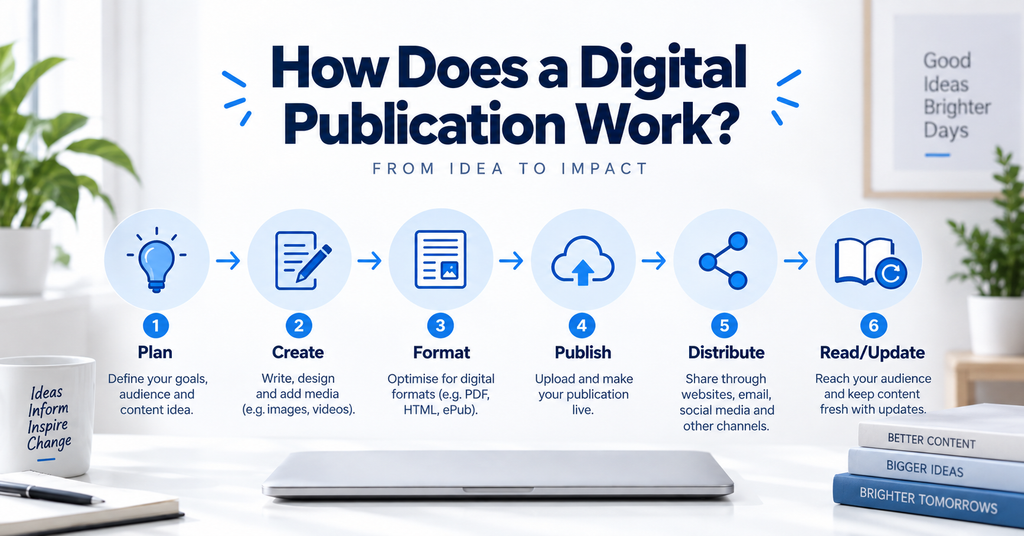
The exact workflow varies, but most digital publications pass through several basic stages.
- Define the audience and purpose.
- Plan and create the content.
- Edit and organize it.
- Choose an appropriate format.
- Design and format the publication.
- Build navigation and accessibility.
- Add multimedia or interactivity where useful.
- Test the publication.
- Publish and distribute it.
- Update or measure it where the format allows.
The final publication might be a PDF file, EPUB, responsive website, flipbook or application.
Digital Publication Formats Compared
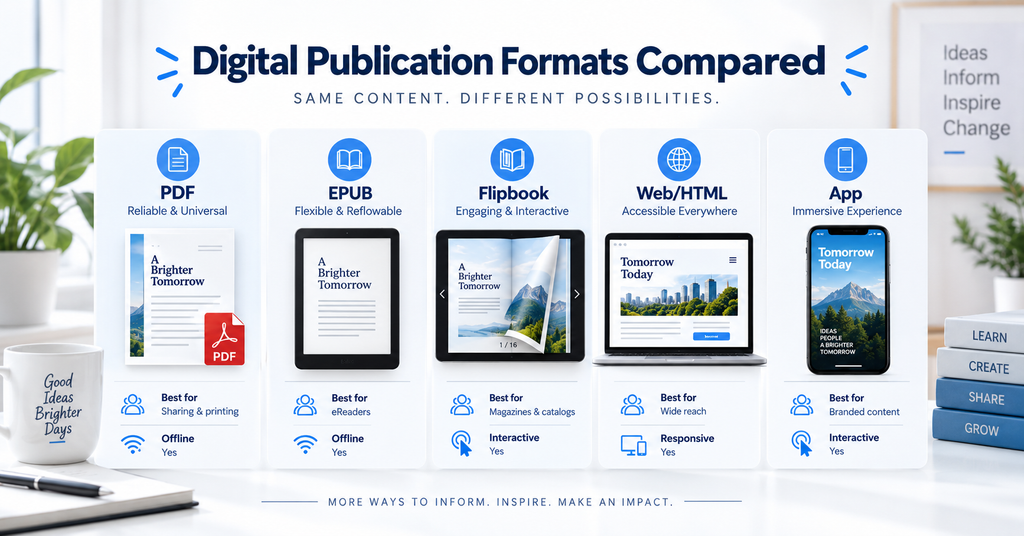
PDF is useful when preserving a designed page layout is important.
It is familiar, downloadable and widely supported.
Its main limitation is that fixed-layout documents can require zooming or horizontal movement on smaller screens. Updating copies that readers already downloaded can also be difficult.
EPUB
EPUB is widely used for eBooks and other reading-focused publications.
Reflowable EPUB content can adapt to the reader’s screen and typography preferences.
Current W3C EPUB standards also contain dedicated accessibility requirements.
Flipbook
A flipbook typically presents page-based content inside a browser viewer and often imitates the experience of turning printed pages.
Platforms may add links, video, forms or analytics.
Flipbooks are nevertheless only one form of digital publication. A page-turn animation does not automatically improve accessibility or mobile usability.
Web-Native Publication
A web-native publication is designed primarily for screens rather than as a copy of printed pages.
It can use responsive design, scrolling, multimedia, data visualizations, forms, internal search and other web functionality.
Its content can also often be updated centrally.
App-Based Publication
Publishers may distribute publications through dedicated applications.
Apps can support notifications, offline storage, subscriptions and device-specific functionality, but they also introduce development, maintenance and app-store considerations.
Does a Digital Publication Have to Be Interactive?
No.
A digital publication can be:
Static: a straightforward PDF report.
Lightly interactive: a publication containing bookmarks and hyperlinks.
Highly interactive: a publication containing animation, video, forms, quizzes, product hotspots or interactive data visualizations.
Interactivity is a capability, not a universal requirement.
What Can a Digital Publication Include?
Depending on its format, a digital publication may contain:
- text;
- photographs;
- illustrations;
- charts;
- audio;
- video;
- animation;
- hyperlinks;
- maps;
- forms;
- interactive graphics;
- quizzes.
Different publication formats support these features differently.
For example, PDF, EPUB, HTML and app-based publications do not offer identical capabilities.
What Makes a Digital Publication Accessible?
Digital publications are not automatically accessible simply because they are electronic.
Accessibility can involve:
- meaningful heading structure;
- logical reading order;
- alternative text for meaningful images;
- keyboard-accessible controls;
- descriptive links;
- captions for video;
- transcripts for audio;
- readable contrast;
- text resizing;
- appropriate metadata;
- accessible navigation;
- compatibility with assistive technologies.
W3C’s EPUB accessibility work provides content requirements and accessibility metadata designed to improve the accessibility and discoverability of EPUB publications.
Accessibility should therefore be planned during creation rather than added as an afterthought.
Should a Digital Publication Work on Mobile?
For many modern audiences, mobile usability is important.
Web-native publications can use responsive design to adapt to screen size.
Reflowable EPUB publications can usually adapt text to smaller screens.
Fixed-layout PDFs and replica-style publications can be more difficult to read on phones if they were designed primarily around large printed pages.
The right approach therefore depends on the publication format.
Can Digital Publications Appear in Google Search?
Some can.
Public HTML pages are generally suitable for web indexing, and search engines can also index some PDFs.
Other implementations may present difficulties, especially when publications sit behind logins, rely heavily on JavaScript viewers, appear inside embedded frames or duplicate material available elsewhere.
Searchability within a publication is also different from visibility in a web search engine.
A PDF might have internal text search without necessarily having the same search-engine visibility as a well-structured HTML publication.
How Are Digital Publications Distributed?
Common distribution methods include:
- publisher websites;
- direct downloads;
- email;
- eBook stores;
- apps;
- subscription services;
- digital newsstands;
- learning-management systems;
- embedded publication viewers;
- social-media links.
The distribution channel should not be confused with the publication format.
A report promoted on social media does not become a social-media publication merely because the link was shared there.
What Are Digital Publications Used For?
Digital publications serve many purposes.
Publishing: books, magazines and newspapers.
Business: annual reports, company reports and catalogs.
Marketing: white papers, brochures, lookbooks and guides.
Education: textbooks, course guides and scholarly journals.
Government and nonprofits: research, public-information documents and reports.
Associations: newsletters, member magazines and industry publications.
Advantages of Digital Publications
Depending on the format, a digital publication may provide:
- rapid electronic distribution;
- easy duplication;
- searchable text;
- hyperlinks and navigation;
- multimedia;
- interactivity;
- global electronic availability;
- accessibility features;
- centralized updates for hosted publications;
- analytics where supported;
- no requirement for physical inventory.
These advantages are not universal.
For example, a downloaded PDF does not automatically provide detailed analytics, and an old local copy cannot necessarily be updated when the publisher edits a newer version.
Limitations of Digital Publications
Possible limitations include:
- dependence on digital devices;
- screen fatigue;
- poor accessibility when badly produced;
- compatibility differences;
- reliance on platforms or vendors;
- privacy implications of reader tracking;
- internet requirements for some formats;
- awkward mobile reading in fixed layouts;
- software and hosting costs;
- long-term preservation challenges.
Digital formats also require devices, networks, data centers and electricity.
It is therefore safer to say that digital distribution can reduce requirements for paper, printing, physical storage and transportation than to claim that every digital publication is automatically more environmentally friendly.
Digital vs Print Publications
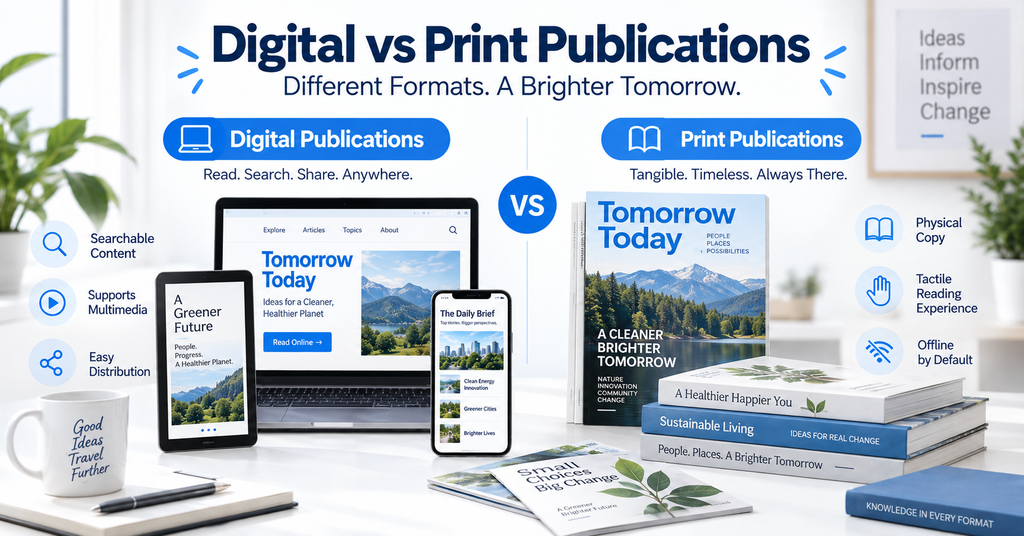
Digital publishing has not made print meaningless.
Print remains useful for physical events, premium publications, art and design projects, local distribution, archives and audiences that prefer physical reading.
Digital publications provide different capabilities, particularly electronic delivery, search, links and multimedia.
Many publishers therefore use both formats.
Web-Native vs Print-Replica Digital Publications
A print-replica publication preserves the appearance and page structure of its print counterpart.
PDF and many flipbooks follow this approach.
A web-native publication is designed primarily for screens and may use responsive layouts, scrolling and embedded media.
Neither is automatically better.
A carefully designed annual report may need fixed pages, while a publication intended mainly for smartphone readers may benefit from responsive HTML.
Which Digital Publication Format Should You Use?
Start with the reader’s requirements.
Choose PDF when preserving the designed layout and providing a simple download matter most.
Choose EPUB when creating a reflowable eBook or long-form reading experience.
Consider a flipbook when a print-like page experience is important.
Choose web-native HTML for responsive, frequently updated or highly interactive publications.
Consider an app when notifications, account integration or deeper device capabilities justify the additional complexity.
No single format is best for every publication.
How to Create a Digital Publication
1. Define the audience and goal
Know who will read the publication and what they need from it.
2. Plan the structure
Organize chapters, sections, navigation and supporting media before designing pages.
3. Create and edit the content
Fact-check the material and establish a consistent editorial style.
4. Choose the format
Decide whether the project needs PDF, EPUB, HTML, a flipbook, an app or another approach.
5. Design for screens
Use readable typography, strong hierarchy, appropriate spacing and touch-friendly controls where relevant.
6. Add navigation
Tables of contents, bookmarks, menus, internal links and search can make longer publications easier to use.
7. Use multimedia selectively
Add audio, video or interactive elements because they improve comprehension—not simply because the technology allows them.
8. Build accessibility into the publication
Consider structure, alt text, navigation, captions, reading order and assistive-technology compatibility.
9. Test it
Check relevant browsers, devices, reading applications and assistive technologies.
10. Publish and distribute
Deliver the work through the channels appropriate to your audience.
11. Maintain it
For publications that can be updated, establish versioning and editorial-maintenance procedures.
Conclusion
A digital publication is best understood as an organized work released in electronic form, not as one particular file type or publishing platform.
It may be a PDF, EPUB, digital magazine, online newspaper, report, catalog, newsletter, app or web-native publication. It can be static or interactive, downloadable or browser-based, free or paid.
The key distinction is simple: the publication is the content readers receive; digital publishing is the process used to create and distribute it.
FAQ’s
What is meant by digital publication?
A digital publication is an organized work released electronically for an audience to read or view on digital devices.
What are examples of digital publications?
Examples include eBooks, digital magazines, online newspapers, research journals, reports, catalogs, brochures, newsletters and white papers.
What is the difference between digital publishing and a digital publication?
Digital publishing is the process of creating and distributing electronic content. A digital publication is the resulting work readers access.
Is a PDF a digital publication?
It can be. A PDF report, book, magazine or brochure may be a digital publication. PDF itself is simply the file format.
Is an eBook a digital publication?
Yes. An eBook is one of the most common forms of digital publication.
Is a website a digital publication?
Sometimes. An editorial website such as an online magazine may function as a publication, while a banking, ecommerce or software website generally serves a different primary purpose.
Do digital publications need internet access?
Not always. Downloadable PDFs and EPUB files can often be read offline after they have been obtained.
What is an interactive digital publication?
It is a digital publication that includes features that respond to reader interaction, such as links, video, animation, forms, quizzes or interactive graphics.
What format is best for a digital publication?
It depends on the project. PDF is useful for fixed layouts, EPUB for reflowable books, HTML for responsive web publications and apps for publication experiences requiring deeper device integration.
